Product tour
From one request to a governed application.
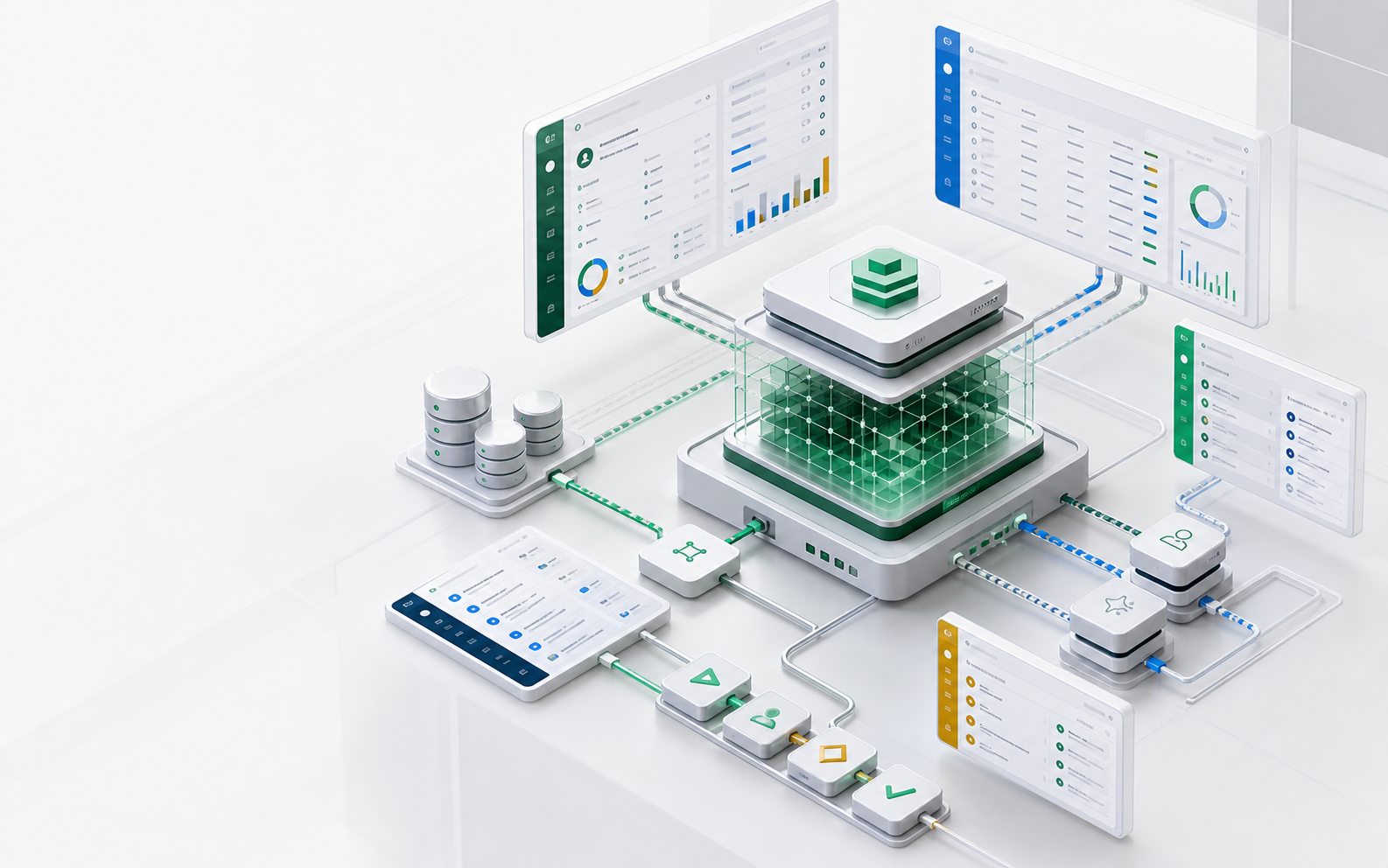
One executable business ontology. AI writes it, the runtime runs it, agents operate it, you own it. Want the same loop hosted, in the browser, nothing to install? That's ObjectOS, the commercial runtime environment built on ObjectStack.
- <150k tokens
- A complete CRM including UI — one context window
- <100k tokens
- Objects, workflows, permissions, and business logic
- ~50k tokens
- The UI metadata for the complete CRM
Review surface
The diff is the product boundary.
Instead of asking a reviewer to audit a generated application codebase, ObjectStack gives the agent an open, typed definition layer to change: objects, fields, views, permissions, workflows, actions, APIs, and tools.
import { ObjectSchema, Field } from '@objectstack/spec/data';

export const Case = ObjectSchema.create({
  name: 'support_case',
  label: 'Case',
  fields: {
    subject: Field.text({ label: 'Subject', required: true, searchable: true }),
    customer: Field.lookup('crm_account', { label: 'Customer' }),
    priority: Field.select({
      label: 'Priority',
      options: [
        { label: 'Low', value: 'low', default: true },
        { label: 'Normal', value: 'normal' },
        { label: 'Urgent', value: 'urgent', color: '#EF4444' },
      ],
    }),
    status: Field.select({
      label: 'Status',
      trackHistory: true,
      options: [
        { label: 'New', value: 'new', default: true },
        { label: 'Triage', value: 'triage' },
        { label: 'Waiting', value: 'waiting' },
        { label: 'Resolved', value: 'resolved' },
      ],
    }),
  },
});
How it works
The governed build loop
The product loop is designed around the two readers that matter: the AI that writes the system and the human who must understand and approve it.
1. Describe the business change
Start with a real operating request: a case queue, approval chain, procurement flow, customer portal, or workflow that already has owners and rules.
2. Agent writes metadata
The coding agent edits Strict TypeScript ObjectStack definitions that must conform to the published Zod schemas instead of generating controllers, screens, migrations, APIs, and permission glue by hand.
3. Reviewer signs off
After the validation gate passes, the reviewer checks a compact diff: field names, relationships, permissions, transitions, workflow rules, and tool exposure.
4. Runtime supplies surfaces
The ObjectStack runtime derives tables, views, forms, ObjectQL, APIs, audit trails, MCP tools, and admin surfaces. ObjectOS operates the resulting app in production.
5. Agents operate inside policy
AI can query and act through governed tools that inherit identity, record rules, field rules, approvals, and audit logging.
Existing systems
Add an object layer without replacing systems of record
Most enterprise software value is already trapped in databases, ERP, CRM, ticketing, files, and custom systems. ObjectStack gives agents an explicit object model over that estate; ObjectOS gives teams a production platform for operating apps built on it.
Connect databases and APIs
Map existing records into business objects, relationships, calculated fields, and actions without forcing a rip-and-replace migration.
Keep authority explicit
Each object says who can read, write, approve, export, automate, or expose it as a tool. That authority remains visible in review.
Ship new surfaces on top
The same definition can back internal apps, dashboards, portals, workflows, APIs, reports, and AI agent tools.
Decision surface
What changes, who reviews it, what runs
| Layer | AI writes | ObjectStack runtime derives |
|---|---|---|
| Data model | Objects, fields, relationships, validations | Tables, migrations, ObjectQL, generated APIs |
| Experience | Views, forms, dashboards, actions | Rendered UI, navigation, status states, access checks |
| Governance | Roles, row rules, field rules, approvals | Runtime enforcement, audit log, user-scoped tools |
| AI surface | Agent tools, skills, prompts, action contracts | MCP exposure, policy checks, execution records |
Review checklist
A reviewer should be able to answer
- What business objects changed?
- Which people, roles, and agents gained authority?
- Which actions need approval before execution?
- Which data can leave the runtime, if any?
- What will appear in audit logs after the change?
FAQ
Questions this page should answer
Is ObjectOS a low-code builder?
No. Low-code usually optimizes human screen building. ObjectOS is the commercial runtime environment built on ObjectStack. The ontology is the software. An agent writes it, a person reviews the diff, and the ObjectStack runtime keeps metadata reviewable and enforces governance on every call.
How do ObjectStack and ObjectOS differ?
ObjectStack is the open-source stack: it defines and runs the application as one open, versioned business ontology — objects and fields, relations, actions, permissions, flows, and agent and tool definitions. ObjectOS is the commercial runtime environment built on ObjectStack, adding the in-app AI Build and Ask experience, team operation, deployment choices, and enterprise support. ObjectOS runs hosted in the browser with nothing to install (ObjectOS Cloud) or self-managed on your own infrastructure (ObjectOS Enterprise), and on either edition you can export your ontology and run it on the open-source ObjectStack runtime.
Next pages