Why AI Agent Pilots Fail Before Production: The Four Missing Layers
A project drew applause on demo day, then was killed four months later by one question from legal. The problem was not the model; it was missing semantics, permissions, approvals, and audit.
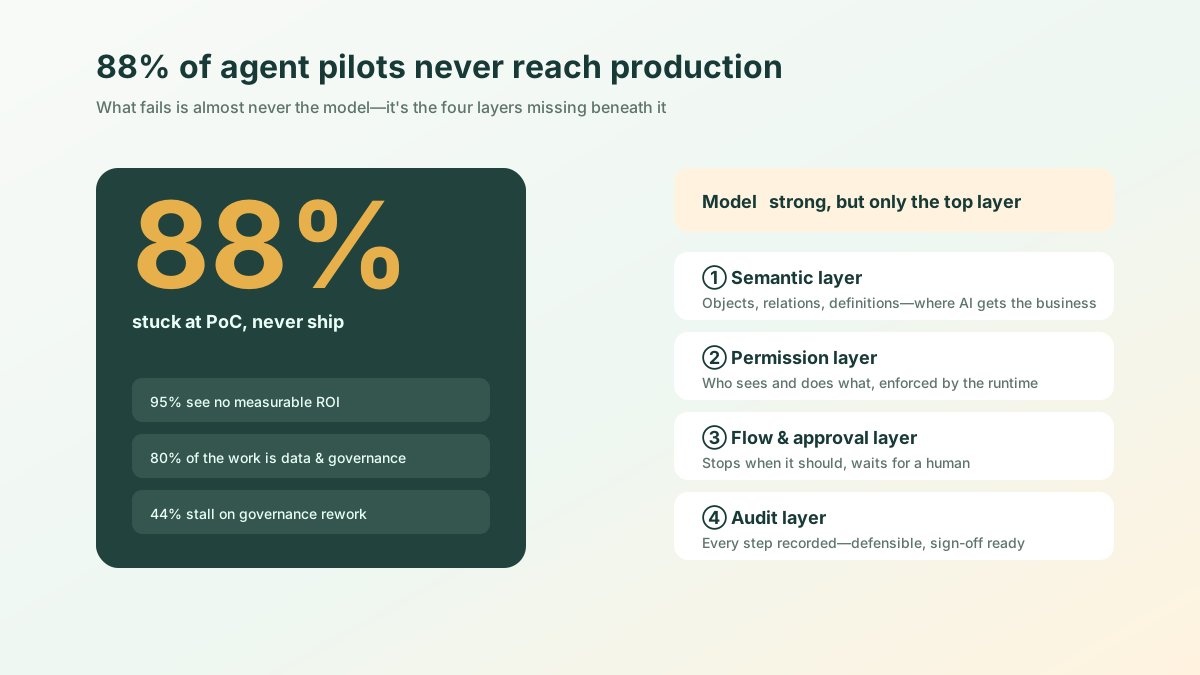
The short version: Agent pilots that never ship usually do not lose on the model. They lose because four layers are missing underneath: semantics, permissions, approval, and audit. A stronger model will not fix that; those four layers will.
That project drew applause on demo day.
Chen, the business lead who championed it, remembers it well: the customer-service agent answered seven or eight tricky questions live, fast and accurate, and people in the room clapped. An executive committed to expanding the investment on the spot — budget, headcount. It was one of the rare high points of his career.
Four months later, the project was quietly shut down. The budget was written off as a sunk cost, and Chen’s credibility with leadership took a hit along with it.
What killed it was not the model; the model performed strongly throughout. It was a question legal asked in a launch review: “When this agent answers Customer A, can you guarantee it will not pull Customer B’s information into the answer? How do you prove it cannot?”
No one could prove it. Not because it would definitely leak, but because there was simply no place in the system that could stop it, or say afterward whether it had ever done so. In that moment Chen understood: from start to finish, the problem was never the model.
He is not alone. Industry reports vary, but they rhyme: many agent pilots stall before production, many show no measurable return, and Gartner has warned that a large share of agentic AI projects will be cancelled by 2027. So many high points walk into the same quiet ending.
Why Swapping In a Stronger Model Does Not Help
Faced with this pattern, most teams’ first reaction is the same: the model is not strong enough. So they swap in a bigger model, tune sharper prompts, and layer on more complex orchestration.
The pass rate barely moves, because the problem is usually outside the model. From pilot to production, much of the work is data engineering, governance, process integration, and metrics; the model itself is only one slice. Many pilots do not die of “not smart enough.” They die because several layers beneath the model are missing. Those layers cannot be filled by any model, however strong, because they are not on the model’s side at all.
Is There Anything Wrong With Doing a Quick PoC First?
Here we have to take on a rebuttal that sounds airtight: building a demo first, running a PoC to validate value, is the right thing to do — should you really over-engineer a demonstration from day one?
There is nothing wrong with a PoC itself. The problem is that it often validates the wrong thing.
Chen’s demo validated “how well the model answers.” What it did not validate, and was designed not to touch, were the four layers that actually decide production readiness: permissions, definitions, approvals, and records. So the PoC gave leadership false confidence: since the demo went smoothly, expanding the investment should be low-risk, right? Four months later everyone discovered that a smooth demo and a viable production system are not the same thing.
So a correct PoC should not only ask “can the model answer correctly?” It should also ask “can this answer be safely delivered to the right person, in a real environment where permissions, approvals, and recording are all in place?” Validate the wrong target, and the prettier the demo, the deeper the pit.
A Demo Does Not Need Those Four Layers, So It Can Deceive You
Why does a smooth demo decouple so completely from production? Because a good demonstration is designed not to trigger any governance question — it uses one exported dataset, shows it to one person, and never asks “can this user see this record” or “does this step need approval first.”
So there is a cruel corollary: a successful demo can systematically hide the reason it will fail later. The prettier what you see, the deeper the layers being hidden. The moment you connect production data, the environment changes entirely, and what decides success is whether these four layers exist beneath the model:
| What it must be able to answer | Which layer is missing | What happens if it’s missing |
|---|---|---|
| What does “customer” actually mean? Where’s the definition? | ① Semantic layer | Off-topic answers, clashing definitions, the business doesn’t accept it |
| Will Customer A’s info get applied to Customer B? | ② Permission layer | Privilege-exceeding leak, legal vetoes it |
| Should this step wait for human approval first? | ③ Process & approval layer | What should stop doesn’t stop; no one dares let it act |
| Who did this operation, when, and based on what? | ④ Audit layer | Can’t produce evidence, compliance stops it cold |
Chen’s project died on row ②.
Why These Four Layers Are Often Absent
So why not build them up front? Because under the traditional approach, each layer is a block of cross-cutting hard engineering: the semantic layer has to align many systems’ data into a unified object model; the permission layer has to collect rules scattered across app code into a consistent policy; approvals have to integrate with existing systems; audit has to merge human and AI actions into one ledger. They are not part of any one feature. They are the foundation underneath all features, and they are mostly invisible in a demo.
Worse, many teams rebuild these four layers separately for each pilot. This round ends, the scenario changes, and the four layers start over. Budget and patience are burned on repeatedly rebuilding foundations.
To judge whether your pilot can reach production, you don’t have to wait four months — asking one question against each of the four layers is enough:
- Semantic: Ask the agent the same business question through different people — is the definition consistent? Or does each get a different answer?
- Permission: Can you prove it will only let each person see the data they have the right to see?
- Approval: For high-risk actions, does it automatically stop and wait for a signature, or just do it?
- Audit: Pick any thing it has done — can you pull up its full record?
Answer “yes” to all four and you have a much better chance of reaching production. Answer “not sure” to even one, and you are closer to Chen’s risk profile.
What Successful Pilots Look Like
It is worth looking at a counterexample, because its difference from Chen is precisely not in the model.
Another company built almost the same customer-service agent, with an even plainer model. But they didn’t start from “making the model answer beautifully” — they first built the four layers on a unified runtime: customers, orders, and tickets were all the same set of objects (semantics in place); the agent acted under the asking rep’s identity and could only see what that rep had the right to see (permissions in place); over-limit refunds automatically went to a human (approval in place); every action landed on the same ledger (audit in place).
Their demo day was not as explosive as Chen’s: solid answers, but not dazzling. Yet in the launch review, when legal asked the same question, the project manager pulled up the permission set and an audit record on the spot, proving the agent could only act under a rep’s identity, see what the rep had the right to see, and that privilege escalation would be stopped by the runtime and left in a record. Legal nodded; the project was cleared.
That is the difference: successful pilots do not win only on the model; they build the four layers ahead of time, so they can withstand the question “how do you prove it?” What Chen lost was not technical sophistication. It was sequence. He put the model first and left the layers that decide production readiness for last.
The Limits: Even With All Four Layers, Success Is Not Guaranteed
Be honest here, or this becomes another cure-all.
There is also a change-management side: people may not use the system, processes may not change, and the organization may not accept it. This does not contradict “dying of the missing four layers.” They are two sides of one thing: a system legal will not clear and the business will not accept cannot even get an entry ticket to adoption. Conversely, having all four layers only gets you the entry ticket; it is not winning the game.
Technical readiness is a necessary condition, not a sufficient one. The four layers make an agent’s actions controllable, traceable, and explainable, so the organization can trust and adopt it. But to truly land, you still need someone to drive the process change and teams willing to change their habits. Anyone who says “fill in these four layers and the pilot will definitely succeed” is over-promising. It clears the technical causes of death; it cannot clear the organizational ones.
The Way Out: The Four Layers Come From the Runtime, Not Rebuilt Per Project
What changes the odds is not a stronger model; it is making these four layers no longer a per-project DIY effort, but capabilities the runtime brings built in.
Take an equipment-repair scenario. You only declare the object and its permissions:
export const RepairTicket = ObjectSchema.create({
  name: 'ops_repair_ticket',
  label: 'Repair Ticket',
  fields: {
    device: Field.lookup('ops_device', { label: 'Device', required: true }),
    cost: Field.currency({ label: 'Repair Cost', min: 0 }),
  },
});
The remaining four layers are delivered by the open ObjectStack runtime: the semantic layer, where this declaration is the basis for the agent to understand the business; the permission layer, where read and write access is enforced on every call; the process and approval layer, where “repair cost over the limit goes through approval” is a declarative process attached to the object; and the audit layer, where every human and agent action lands on the same ledger. Switch to the next scenario and the four layers do not have to be rebuilt; you declare a few more objects.
Had Chen’s project been built this way, legal’s question would not have been a death sentence. He could have pulled up the permission set and proved the agent could only act under the asker’s identity and see what the asker had the right to see. The second layer was already beneath his feet.
Closing
The pilots that reach production rarely rely only on the best model. They rely on the four layers beneath the model: semantic, permission, process, and audit. They also rely on the organization actually putting the system to use. The former is the entry ticket; the latter is the game. You need both.
So if your agent pilot is stuck again, do not rush to swap models. Ask the question Chen learned to ask only four months too late: how many of the four layers beneath it are actually built? That is cheaper than tuning another version of the prompt, and it can save both the project and the person accountable for it.
npm i -g @objectstack/cli && os startDeclare an object and its permissions, have an agent use it, and you will find the four layers already beneath its feet.