Platform
Everything a business system needs. Ready for production.
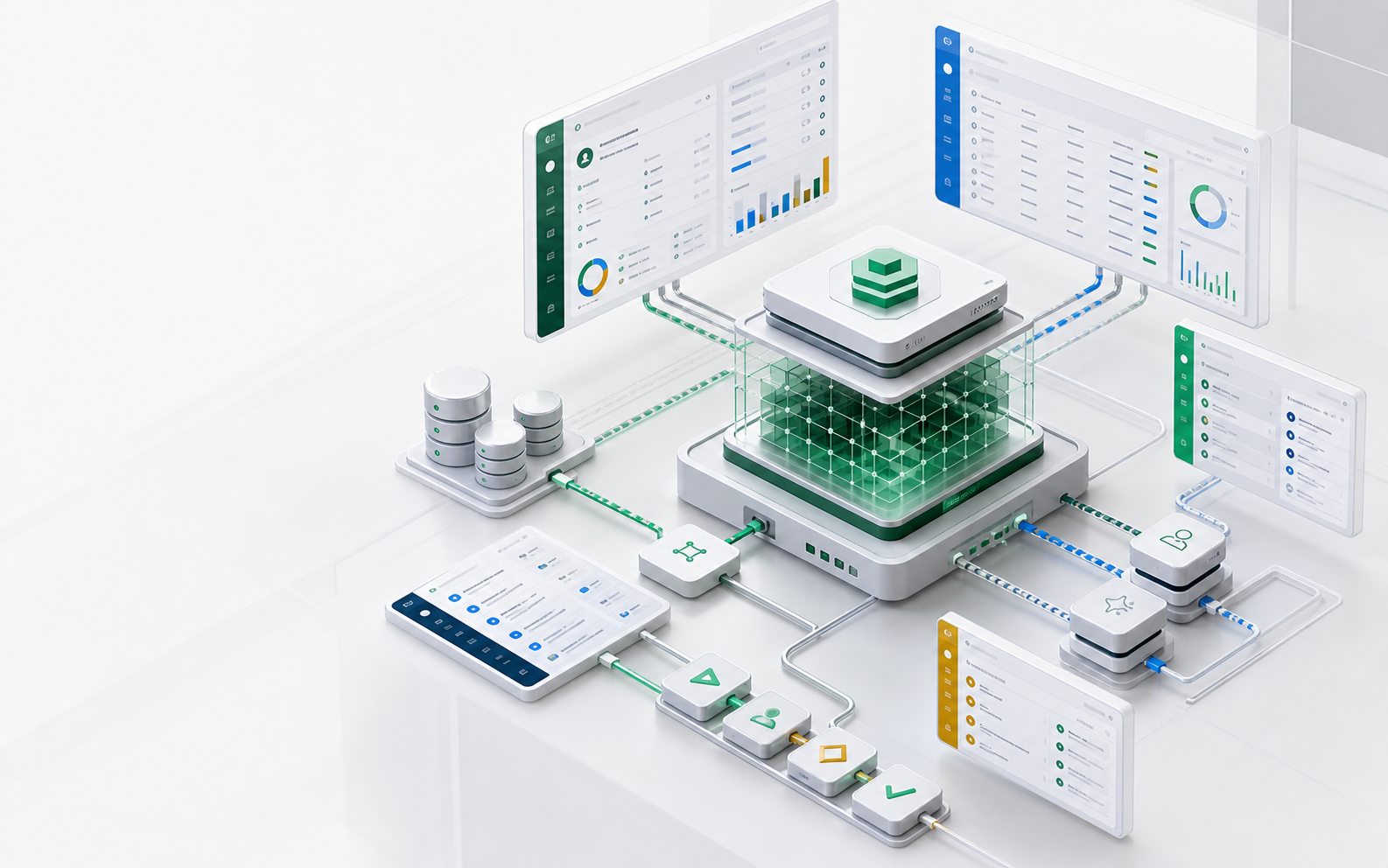
Your agent describes the business as one typed ObjectStack ontology. The open ObjectStack runtime derives the database, APIs, permission-aware screens, automated processes, approval queues, and dashboards, enforcing governance on every call. Want the same loop hosted, in the browser, nothing to install? That's ObjectOS, the commercial runtime environment built on ObjectStack.
- 25+
- Runtime services behind every deployed application
- 6
- Capability areas, from data modeling to analytics
- <150k tokens
- A complete CRM including UI, held in one context window
Typed metadata your agent writes
One definition. A whole application behind it.
This is the shape of a governed order object. Permission sets, approval flows, views, and AI tools are sibling ObjectStack definitions in the same reviewable target format, while the ObjectStack runtime derives tables, APIs, screens, queues, and audit.
import { ObjectSchema, Field } from '@objectstack/spec/data';

export const Order = ObjectSchema.create({
  name: 'sales_order',
  label: 'Order',
  fields: {
    customer: Field.lookup('crm_account', { label: 'Customer', required: true }),
    total: Field.currency({ label: 'Total', min: 0 }),
    discount: Field.percent({ label: 'Discount', max: 30 }),
    status: Field.select({
      label: 'Status',
      trackHistory: true,
      options: [
        { label: 'Draft', value: 'draft', default: true },
        { label: 'Submitted', value: 'submitted' },
        { label: 'Approved', value: 'approved' },
        { label: 'Fulfilled', value: 'fulfilled' },
      ],
    }),
  },
});
Capability map
Six capability areas, one open governed runtime
The same capabilities you would expect from a mature business platform — except your AI writes the ObjectStack definition and its runtime does the assembly.
Data modeling
Objects, relationships, and validations become tables, migrations, a query language, and REST APIs — on Postgres, MySQL, SQLite, MongoDB, and more.
App interfaces
Forms, views, and dashboards render straight from metadata, and every user sees exactly what their permissions allow — no hand-built frontend.
Process automation
Flows with durable pause and resume, record-change, scheduled, and API triggers, background jobs, and reliable webhook delivery.
Approvals
Multi-step approvals with user, role, team, and hierarchy resolution, escalation, and record locking while a decision is pending.
Permissions & security
Role-based, row-level, and field-level control with record sharing, tenant isolation, and an immutable audit trail.
Analytics & reporting
Aggregations, time series, funnels, and dashboards over the same governed objects — no separate BI stack to wire up.
Built for AI
Designed to be written by agents, reviewed by people
Every ObjectStack capability above is defined as metadata, which is what makes metadata driven development work when the author is an AI: a whole-context definition, readable diffs, and runtime enforcement. ObjectOS adds the in-app AI and production experience for teams.
AI Build & Ask
In ObjectOS Cloud and Enterprise, describe a change in natural language and review the diff, or ask questions over live business data — always inside the signed-in user’s permissions.
Tools & MCP
Objects, queries, and actions become policy-checked tools for Claude, Cursor, or any MCP client — declared as metadata, never handwritten glue.
Designers & console
16+ open-source ObjectStack admin surfaces — the object designer, flow canvas, approvals inbox, permission matrix, and audit viewer — so people fine-tune everything the AI drafts.
The review loop
Structural changes land as compact diffs in an approval queue, so a person signs off before the runtime ships anything.
Decision surface
What changes, who reviews it, what runs
| Business need | AI writes | ObjectStack runtime derives |
|---|---|---|
| A customer database with an API | Objects, fields, relationships | Tables, migrations, query language, REST endpoints |
| Screens for each team | Views, forms, dashboards | Rendered UI that respects each user’s permissions |
| An approval before discounts ship | A flow rule with an approval step | Approval queues, escalation, record locking, audit |
| AI that answers from live data | Tool and action contracts | Policy-checked MCP tools scoped to the signed-in user |
FAQ
Questions this page should answer
Which capabilities are in the open-source ObjectStack?
The runtime capabilities on this page — data, UI, automation, approvals, permissions, analytics — are part of the open-source ObjectStack target format and runtime. You bring your own AI: a coding agent writes metadata as source files and any MCP client can query your objects. The in-app AI Build and Ask assistants are ObjectOS Cloud and Enterprise capabilities.
Can it run in our own infrastructure?
Yes. The open-source ObjectStack runtime can be self-hosted. ObjectOS Enterprise also supports private deployment in a VPC, on local servers, or in air-gapped networks, with local models, internal identity, your own secret management, and enterprise support.
Next pages