Retool vs. Governed AI App Platforms: Can You Review Business Authority?
Retool has strong access governance, including RBAC, audit logs, SSO, and self-hosting. The harder question is whether business authority is declared as a reviewable fact.
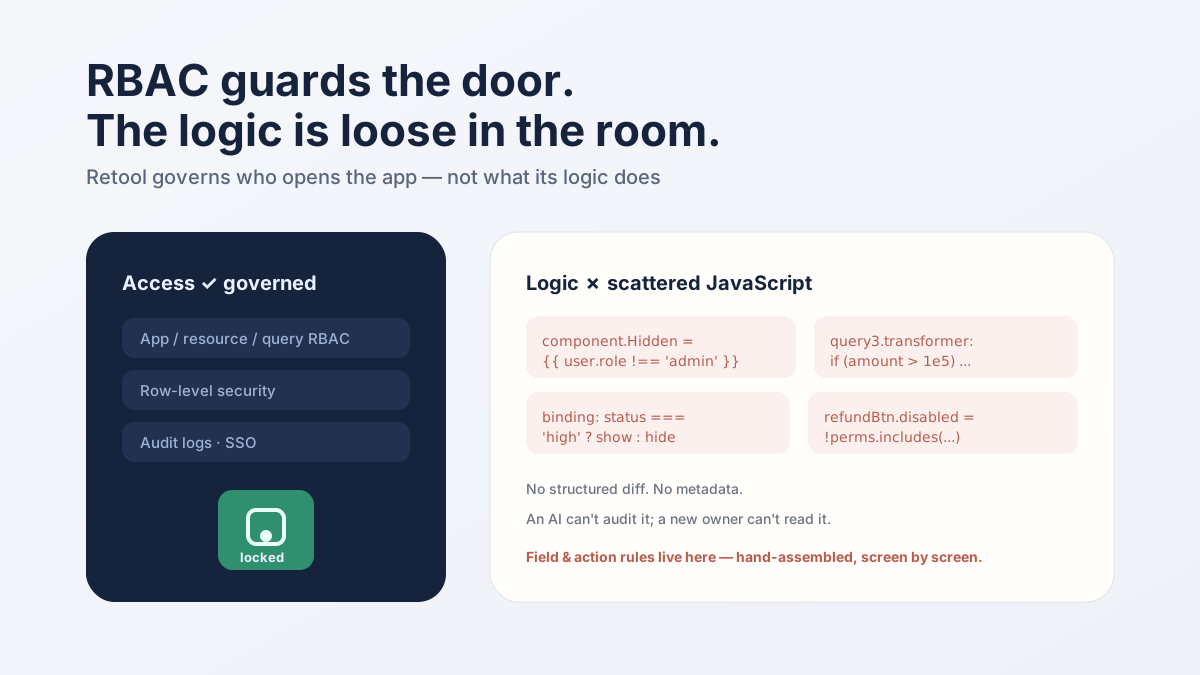
TL;DR: Retool’s access governance is strong: RBAC, query access, row-level controls, audit logs, SSO, and self-hosting on Enterprise. None of that is the problem, and you should not pretend it is. The problem is the layer it governs. RBAC controls which resources a role can reach; the actual business authority, such as “can this person issue a $12k refund?”, often lives in JavaScript scattered across component properties and query logic. No two expressions are guaranteed to agree, a non-engineer may not be able to read them, and an AI can write those expressions faster than any pull request can review them. The gap is not basic security. It is that authority is code, not a declared, reviewable fact.
Picture a very ordinary Retool app: a refund console. An engineer builds it in an afternoon: a table of orders, a “Refund” button, a few queries. Support uses it. It works well. This is Retool at its best.
Now it is six months later. The engineer who built it has changed teams. Security is doing an access review and asks the new owner a one-line question: “Which roles can issue a refund over $10,000, and where exactly is that enforced?”
Watch what the new owner has to do to answer. There is no single place to look. They open the app and start reading JavaScript.
The Grep Test
Here is what “where is it enforced” actually looks like in a real Retool app. The authority to issue a large refund is spread across at least three independent expressions, each hand-written, each a different shape:
// 1. refundButton → "Hidden" property
{{ currentUser.groups.includes('admin') ||
   (currentUser.groups.includes('support_lead') && refundAmount.value <= 10000) }}

// 2. refundAmount input → "disabled" property
{{ !currentUser.groups.includes('support_lead') }}

// 3. issueRefund query → transformer (this is the part that actually writes)
if (refundAmount.value > 10000 && !currentUser.groups.includes('finance')) {
  throw new Error('Refunds over $10k require finance');
}
Three places. Three subtly different conditions. The button hides itself for some users; the input disables itself for others; the query throws for a third set. They are supposed to add up to one coherent rule — “support leads up to $10k, finance above” — but nothing guarantees they do. Hide a button and the underlying query still runs if someone hits it another way. Add a second write path next quarter and forget the finance check, and you have a hole that no screen reveals.
Call this the grep test: to answer “who can do X,” do you read one declared rule, or do you grep the app? If the answer is grep, the app is not governed at the authority layer; it is merely coded. Access governance, which Retool handles well, sits one layer above the thing that can actually hurt you.
For contrast, here is the same authority as a declared fact — one rule the runtime enforces on every path, regardless of which button or query you came through:
action: issue_refund
  who_can_run:
    - role: SupportLead   when: amount <= 10000
    - role: Finance       when: amount  > 10000
  requires_approval:      when: amount > 10000      # a preventive gate, not a thrown error
  audit: always
One place to read. One place to change. One thing for a reviewer — or an AI — to reason about. The difference between three hand-maintained expressions and one declared rule is the entire difference between “the app is coded” and “the app’s authority is governed.”
Why Source Control Does Not Close This
The sharp Retool engineer’s rebuttal is fair and has to be answered precisely: “We have Git-backed source control, audit logs, and RBAC. Changes are reviewed in PRs. Access is governed. What is missing?”
Three things, specifically.
First, a PR on a Retool app is a review of JavaScript and bindings scattered across components — you are code-reviewing, which means (a) it requires an engineer, and (b) there is no structured representation of “this change altered who can issue a large refund.” The reviewer has to notice that a tweak to a Hidden expression three components over changed an authority boundary. Diffs of scattered logic hide exactly the thing you most need to see.
Second, source control reviews code, not authority as a fact. “Did this PR change who can refund >$10k?” is not a question a Git diff answers directly; it’s a question you answer by tracing the code in your head. The declared rule above makes that diff trivial: who_can_run changed, or it didn’t.
Third, and this is the one that matters most for where the industry is going, the whole premise of low-code is that non-engineers and AI change the app, often in the visual editor and often without a PR at all. The governance you are counting on, PR review, may not exist for the changes low-code is for. Audit logs can tell you a Hidden property changed after the fact, but that is detective, not preventive. No one reviewed what authority it granted before it shipped.
AI Does Not Break This. It Multiplies It.
For years the grep test was survivable because a human wrote the JavaScript and another human carried the knowledge of where each rule lived. Scattered logic is navigable if a person built it and remembers it.
Point an AI at the same app and the economics invert in both directions. The AI can generate fifty bindings and a dozen transformers in a minute; it produces authority decisions faster than any reviewer can trace them. To review what it produced, you are back to reading JavaScript across screens, because there is still no single structured representation of authority to diff against. Retool AI and agents are real and useful, but they automate on top of the same app substrate: the agent can be scoped, but the app the agent edits may not express authority in a form an AI, or a human, can review as a fact rather than as code.
The thing AI is fastest at producing is precisely the thing Retool makes hardest to review.
Where Retool Is the Right Call
Be honest in both directions, because a one-sided piece is worthless to someone actually deciding.
Retool’s access governance is genuinely strong, and for a large set of apps the grep test never bites: an internal tool operated by trusted staff, behind SSO, maintained by the same engineers who wrote it, where “support leads can refund up to $10k” is enforced in three places that agree and rarely change. For that, and for the freedom to drop into SQL and arbitrary JavaScript whenever a requirement is unusual, Retool is excellent. We are not going to beat “wire a tool in an afternoon.”
And the declared-metadata model has a real cost in the other direction: you trade raw flexibility for legibility. You cannot paste arbitrary JavaScript into a property when the model does not have a place for it; expressing genuinely unusual logic as declared rules is more constrained than {{ }} anywhere. For a throwaway tool, that constraint is pure overhead. The model pays for itself when “who can do what” is something you will be asked to prove by an auditor, a regulator, or the next owner, and when an AI, not the original author, is doing the changing.
That is the line. Below it, Retool wins on merit. Above it, the grep test is what you fail six months later in front of an auditor or security reviewer.
ObjectStack’s Position
ObjectStack keeps the thing Retool gets right, including strong access control, self-hosting, and your own infrastructure, and moves authority down into the same governed layer. The app’s logic is open, readable metadata: an action like issue_refund carries its own who_can_run, its own approval gate, and its own audit requirement, declared once and enforced by the runtime on every path. An AI change is a diff against that declared authority. “This change lets SupportLead refund up to $25k” is a line a non-engineer can read and approve before it ships, not a Hidden expression you discover later by grepping.
We will not out-Retool Retool at “drop into JavaScript and ship a tool by lunch.” The claim is narrower and only matters above the line: when AI is writing your internal software, who-can-do-what should be a fact you can read in one place and review as a diff, not an emergent property of three expressions that have to agree until the quarter they do not.