Airtable Omni vs. Governed AI App Platforms: Why Reviewed Diffs Beat Undo
Airtable Omni can build a real app from one sentence, but regulated systems of record need reviewed diffs, preventive controls, and infrastructure choices that go beyond undo.
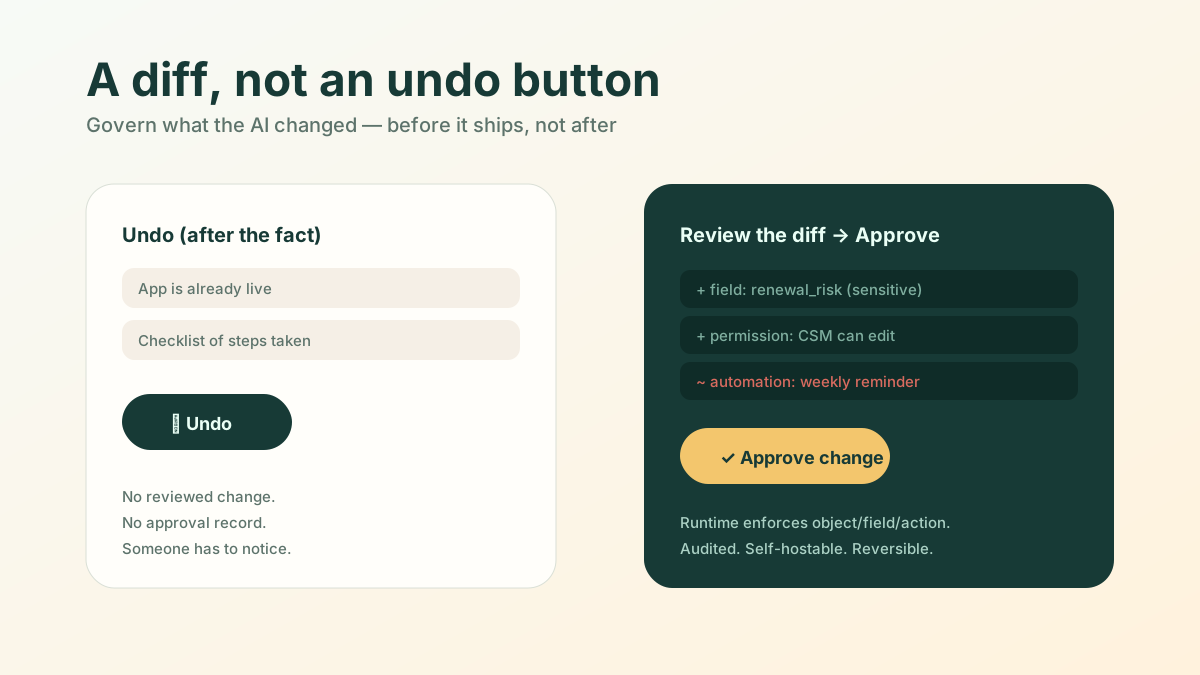
TL;DR: Airtable’s relaunch as an AI-native platform is real: Omni assembles apps from production-tested components, not throwaway code. The gap is not capability; it is control. Omni relies on an undo button and a detective audit log, which means you learn that a control changed after it changed. A regulated system of record needs a preventive control: a reviewed diff approved before it ships, with permissions the runtime enforces on objects, fields, and actions rather than only through views. Add Airtable’s SaaS deployment model, and for some systems of record the platform decision is made before you compare a single feature.
Start with an ordinary Tuesday, because this is where the issue appears: not in the demo, but in daily operations.
A revenue-ops manager opens Omni and types: “Add a renewal-risk field to Customers, put high-risk accounts on a board, and remind the CSM every Monday.” Omni does it, beautifully. The field appears, the board renders, the automation fires. To compute “risk,” it pulls from the account’s ARR. To make the board useful to the people who chase renewals, it exposes the new field in a view the CSM role can see. Everyone’s happy. The manager clicks away.
Six weeks later a SOC 2 auditor sitting with your security team asks one question: “Customer ARR is confidential. This view exposes a field derived from ARR to the CSM role. Who approved that, and when?”
And the honest answer is: no one approved it, because there was never an approval step. An AI made an access-control decision on a Tuesday, it went live instantly, and the only record that anything happened is an after-the-fact activity entry if anyone thinks to look. That is the whole article. Everything below explains why that gap is structural, not just a missing feature.
The Distinction Your Auditor Already Uses: Preventive vs. Detective
Give Airtable its due first, precisely, because vague criticism is not useful here. Omni is not vibe coding. Its component-based approach is the right direction, and it is better than regenerating fragile code after every prompt. Airtable Enterprise also has real controls: Enterprise Hub, audit logs, org-unit and super-admin roles, EKM/DLP, and advanced permission controls that move toward field and record level. A serious Airtable admin will read a lazy “it has no governance” take and stop trusting you. So do not write that one.
Write the precise one instead. Security and audit frameworks divide controls into two kinds, and your auditor lives by the distinction:
- A detective control tells you something happened after it happened. An audit log is the canonical example. It is necessary and Airtable has it.
- A preventive control stops an unauthorized thing from happening at all. An approval gate on a sensitive change is the canonical example.
Undo is neither. It is not a control; it is an after-the-fact safety net that runs after the change is already live, depends on one person noticing, and leaves no record of who decided the change was acceptable, only that it was reverted. SOC 2’s change-management criteria (CC8.1) and every serious change process exist because, for sensitive changes, detective-only is not enough. You should not discover that ARR was exposed after the fact; the system should stop that exposure until someone signs off.
Here is the same fact mapped onto the framework an auditor will actually apply:
| Omni today | What a system of record needs | |
|---|---|---|
| When the control acts | After the change is live (detective) | Before the change ships (preventive) |
| Human checkpoint | Undo / version history | Approve a diff of exactly what changes |
| Record produced | ”Steps taken” plus a record that the change happened | Who approved this specific change, and why |
| Answer to “who allowed this?” | Reconstruct from logs, maybe | Named approver, attached to the change |
| Failure mode | Someone has to notice in time | The change can’t go live unapproved |
This is why “Omni shows a plan and a checklist and you can undo it” does not close the gap. A plan is a preview, not an approval; a checklist is a receipt, not a control; undo is an after-the-fact recovery tool. None of the three is the preventive checkpoint the ARR-exposure scenario required.
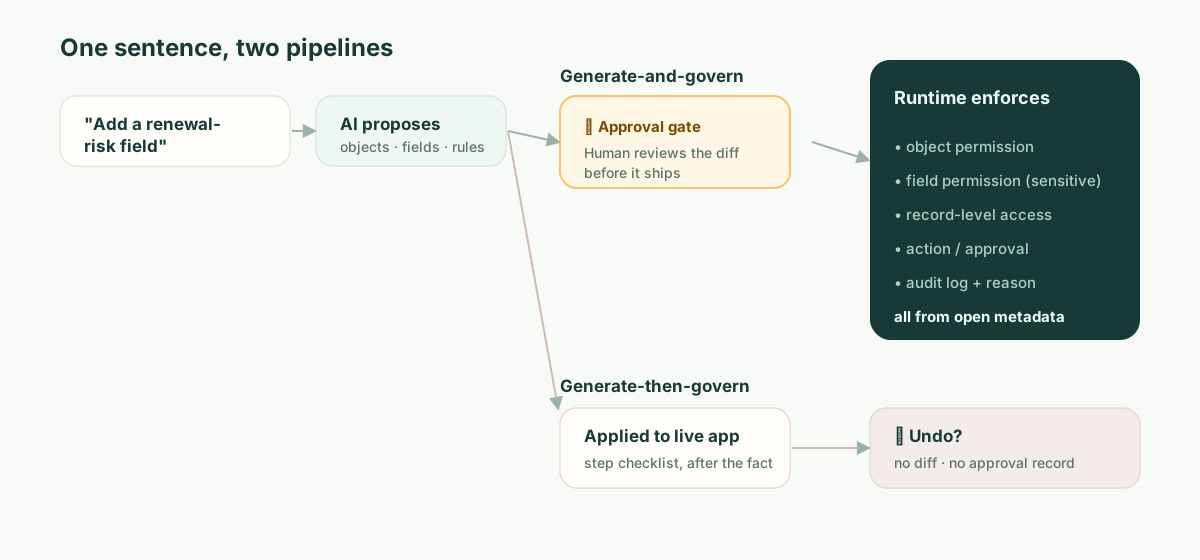
What “Review the Diff” Actually Means
The phrase “reviewed diff” is easy to say and easy to wave away, so here is the concrete thing. When an AI proposes a change to a governed app, the artifact a human approves should make the consequences legible — not the prose of the request, the actual metadata delta:
  object: Customer
+ field: renewal_risk
+   type: enum[low, medium, high]
+   derived_from: account.arr
+   sensitivity: confidential        # inherited from ARR source
+ permission: field.renewal_risk
+   read:  [RevOps, AccountExec]
+   edit:  [RevOps]
!   read:  CSM  ← requested by the new board view — APPROVE? (exposes ARR-derived data)
+ view: "Renewal risk board"  exposes: [account, renewal_risk]
+ automation: notify_csm_weekly
  change #4827 · proposed by Omni · approved_by: __________ · reason: __________
Read what that buys the manager from the opening scene. The field is flagged confidential because it descends from ARR — automatically, because sensitivity is a property of the data, not something a human remembers to tag. And the one line that mattered — the board view wants to grant CSM read access to ARR-derived data — is surfaced as a decision, on its own, before anything ships. The manager (or their security partner) either approves it on purpose or doesn’t. Either way, change #4827 now has a name and a reason attached to it. When the auditor asks in six weeks, the answer exists because the question was forced at the moment of change.
That is the difference between “the AI can build it” and “the AI’s change is governable.” It isn’t about trusting the model less. It’s about the change being a reviewable object instead of an event that already occurred.
The Number: Your Mean Time to Unauthorized Exposure
Here is a figure you can compute for your own organization, because it makes the abstract concrete. Call it mean time to unauthorized exposure (MTUE): from the moment an AI change crosses a line it should not cross, how long until it stops being live?
- With a preventive gate, MTUE is zero by construction. The change that crosses the line never goes live; it waits at the approval step. There is no exposure window.
- With undo + a detective log, MTUE is time-to-detection — and you should price that honestly. Best case, a teammate notices that afternoon. Realistic case, it’s whenever someone audits the view, or the quarterly access review runs, or — as in the scenario — the external auditor finds it first. For data that syncs to other systems (Airtable’s HyperDB default is a once-every-24-hours sync), the exposure can propagate before any human looks.
Plug in your own access-review cadence. If you review sensitive permissions quarterly, your undo-based MTUE for a quiet misconfiguration is measured in weeks to a quarter. The preventive model makes that number zero not by being smarter, but by moving the checkpoint to before the change instead of after. You cannot prompt your way to MTUE = 0; it’s an architectural property of when the human is in the loop.
”But We Already Run Airtable Enterprise and Security Signed Off”
This is the real reader’s position, so meet it directly. Yes — and what your security team signed off on was Airtable’s access model and infrastructure: SSO, encryption, audit logging, the permission tiers. Those are real and that sign-off was reasonable.
It almost certainly predated Omni writing changes to that access model. The question your security team has very likely not been asked is narrow and answerable: “When the AI changes who-can-see-what, what reviews that change before it is live, and where is the named approval?” Take that sentence into your next vendor call. The answer you get back, whether “you can undo it,” “it is in the audit log,” or “Omni shows a plan,” will tell you which side of the preventive/detective line you are standing on. You do not need our opinion for that; you need the question.
Where This Argument Does Not Apply
Intellectual honesty, because the failure mode of a piece like this is to pretend the trade-off is free. The preventive model has a real cost: friction. An approval gate on every sensitive change is exactly the wrong ergonomics for a three-person team iterating on an internal tracker. For them, undo is the correct design, the table UX is a genuine joy, and Airtable’s template ecosystem and time-to-first-app are ahead of anything heavier — including us. We are not going to out-Airtable Airtable on speed-to-first-app, and pretending otherwise would be the same dishonesty in the other direction.
The preventive model only pays for itself when the cost of one unreviewed change exceeds the cost of reviewing changes — i.e., when there’s confidential data, a real permission model, and someone who will eventually audit it. That’s the line. Below it, Airtable wins on merit. Above it, the undo gap is the thing that ends the evaluation, and it ends it before features.
And one more, separate from all of the above and just as final for some buyers: Airtable is a SaaS platform, not a self-hosted runtime. If your runtime must live where your data and your regulators require, because of sovereignty, air-gap, or residency requirements, no amount of governance sophistication helps if the platform cannot run where you need it. For that class of buyer, the comparison is over at the first requirement.
ObjectStack’s Position
ObjectStack is built for the world above that line, and only that world. The application core is open, readable metadata — objects, fields, relationships, permissions, actions — so an AI change is the reviewable diff shown above: a preventive checkpoint a human approves before it ships, with the consequence (this view exposes ARR-derived data to CSM) surfaced as a decision and bound to a named approver. Permissions are enforced by the runtime on the object, record, field, and action, so they can’t be silently rearranged by editing a view. It is self-hostable, and it connects to the CRM/ERP/DB you already run rather than syncing your business into one more cloud.
The pitch is not “as easy as Airtable.” It is not, by design, because the approval step is part of the product. The pitch is this: keep the table-and-chat experience that makes Airtable legible, and put a preventive control, a runtime permission model, and your own infrastructure underneath it, so the answer to “who approved exposing ARR on a Tuesday?” is a name, not a search.