Metadata, Not Code Generation: What Makes AI-Built Apps Governable
Code generation can speed up prototypes, but enterprise applications need a metadata runtime where objects, fields, views, permissions, workflows, actions, and agent tools are governed together.
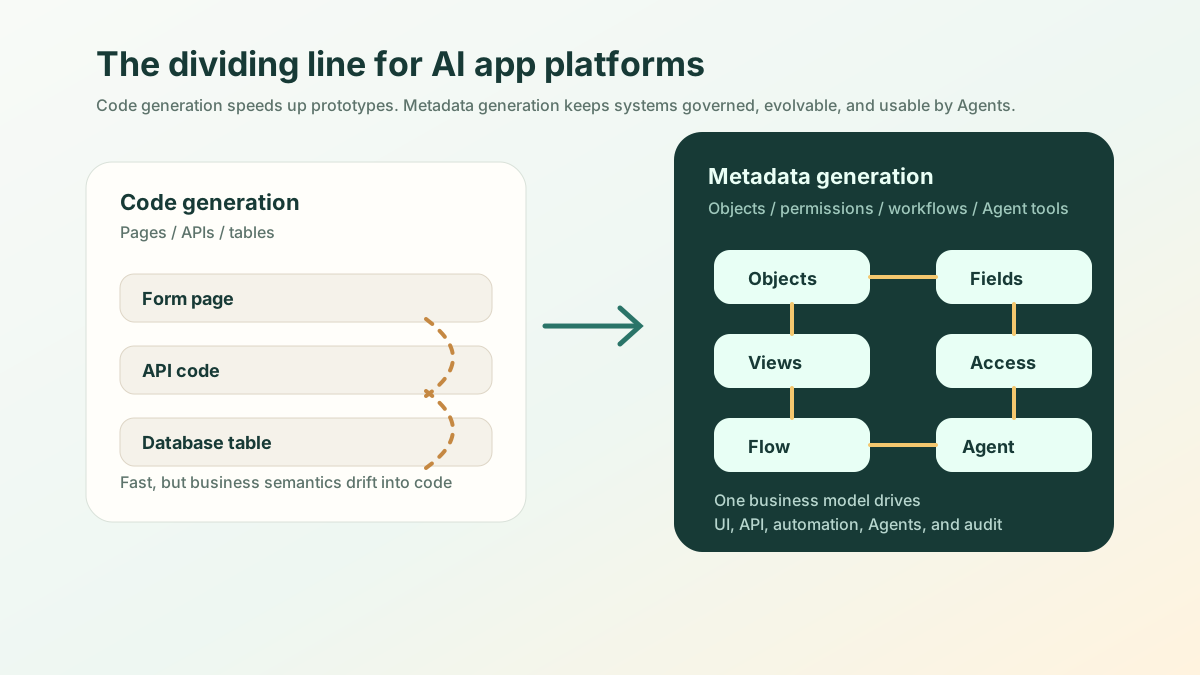
The short version: An AI-built enterprise app should not be a pile of generated code; it should be generated metadata: objects, permissions, flows, and agent tools under one governed runtime. Code runs; metadata is what stays changeable and governable.
Over the past decade, low-code platforms solved a very concrete problem: every internal system should not require teams to write forms, pages, workflows, and admin screens from scratch.
AI now pushes that question one step earlier. If low-code can assemble an application visually, can a business user generate an application from a sentence?
Yes, but there is an easy trap. If “AI-generated applications” means “AI writes a pile of code,” the old enterprise application problems return quickly. The first version looks fast. The second version slows down. Pages render, but permissions are fragile. Forms submit, but workflows are hard to trace. AI can answer questions, but Agents do not know which actions are allowed and which must stop for confirmation.
The core of an AI-native application platform is not code generation. It is metadata generation.
Readers Care Less About Code Than Whether the System Can Change
From the perspective of a business owner or IT leader, the most important question is rarely whether the first version can be generated. The real questions are:
- Can the application change when the business changes?
- When a field changes, do forms, lists, permissions, and workflows change with it?
- When a new approval rule is added, can old records and running processes still be explained?
- Does the AI Agent inherit the user’s permissions?
- Can the organization audit who viewed, changed, confirmed, and approved what?
- Will the system still be maintainable six months later?
Code generation solves the speed of going from zero to one. Metadata solves the structure required for continuous evolution.
This is the lesson low-code platforms learned over many years: an enterprise application is not a set of pages. It is a governed, configurable, upgradeable business model. If an AI Builder falls back to code generation alone, it bypasses the most valuable part of low-code.
Why Code Generation Loses Control in Enterprise Applications
Code generation is useful for prototypes, small tools, and one-off pages. It can quickly create React components, APIs, database schemas, and validation logic.
But enterprise complexity usually lives in cross-layer consistency.
For example, a user says:
Add a “renewal risk” field to customers, and remind the customer success manager every week for high-risk customers.
If this is treated as a code generation task, AI may update the database, form, list, and scheduled job. It appears complete.
In a real business system, the field also affects:
- whether it appears on the customer detail page;
- who can edit the risk level;
- whether managers can see team-wide risk;
- whether exports include the field;
- whether Agents may cite it in customer summaries;
- whether high-risk rules enter audit logs;
- whether changing the risk level triggers notifications;
- how the field migrates if its name changes later.
When these rules are scattered across code, every change becomes a small refactor. The system becomes heavier over time and eventually looks like traditional custom development again.
Metadata Is Not a Config Table; It Is the Runtime Language of the Business
Many people hear “metadata” and think of configuration values. The metadata described here is richer: it is the language the application runtime uses to understand the business.
| Metadata layer | Question it answers |
|---|---|
| Objects | What core business entities exist, such as customers, contracts, tickets, and tasks |
| Fields | What attributes each object has, including type, required status, formulas, and sensitivity |
| Relationships | How objects connect through one-to-many, many-to-many, references, and reverse references |
| Views | How different roles see data through lists, boards, forms, details, and dashboards |
| Permissions | Who can see, edit, and operate on which records and fields |
| Workflows | How states move and which conditions trigger approvals, notifications, and automation |
| Actions | Business operations such as creating tasks, starting approvals, generating reports, and sending reminders |
| Agent tools | What AI can query, suggest, execute, and when it must wait for human confirmation |
| Audit | What AI suggested, what humans confirmed, and what the system finally executed |
These metadata layers drive UI, API, permissions, automation, and Agents together.
A page is one representation of metadata. An API is another. An Agent tool is another. That is how the system avoids different behavior across different entry points.
AI Builder Should Generate an Application Specification, Not Just Code
A mature AI Builder should not start by writing code. It should behave more like a business architect who understands low-code platforms and first generates an application specification.
For example, a user says:
Help me build an after-sales ticketing application. Customers can submit issues, AI automatically classifies them and recommends replies, and enterprise customer tickets escalate when SLA is missed.
The Builder should first produce:
- Primary objects: customer, ticket, message, knowledge base, SLA, escalation record.
- Fields: issue type, priority, sentiment, impact scope, due time.
- Views: support queue, manager dashboard, near-SLA tickets, high-risk customers.
- Permissions: what customers, support agents, managers, and admins can see.
- Workflow: submit, classify, process, escalate, close, review.
- Agent tools: summarize, classify, match knowledge, draft replies, suggest escalation.
- Audit: AI judgment, human edits, send confirmation, escalation reason.
After this specification is confirmed, the platform can generate pages, data structures, automation, and tool calls.
This is not meaningfully slower than generating code directly, but it is far more stable later.
What AI Changes Compared With Traditional Low-Code
Traditional low-code platforms ask users to understand configuration surfaces: object designers, field panels, workflow canvases, permission matrices, and expression editors.
AI Builder should not replace these capabilities. It should reduce the cost of expressing intent.
The user no longer needs to know which configuration panel to open. They can say:
Put high-risk contracts into a legal review board, and add a finance review step when the amount exceeds 500,000.
The platform breaks that sentence into filters, views, workflow conditions, approval nodes, and permission changes, then shows a change plan for confirmation.
That is the real enhancement AI brings to low-code: not making the platform a black box, but letting business language enter platform structure directly.
Six Ways to Judge Whether an AI Builder Is Serious
When evaluating an AI application platform, do not only ask whether it can generate a polished page. Ask:
- Does it generate code, or explainable objects, fields, views, permissions, and workflows?
- Can business users later modify application structure in natural language?
- Are permissions a unified runtime capability, not temporary checks inside pages?
- Can AI Agents access and modify data only through governed tools?
- Is every AI suggestion, human confirmation, and system action audited?
- When business rules change, does the system change metadata or regenerate code?
The answers decide whether the product is a demo tool or an enterprise application platform.
The ObjectStack Difference
ObjectStack’s direction is to let natural language generate metadata, then let metadata drive the runtime.
When a user states a requirement, the platform generates objects, fields, relationships, views, permissions, workflows, actions, and Agent tools. After the application is running, business users continue modifying it in natural language. AI Agents work inside the same object, permission, and action boundaries.
Code still exists, but it is no longer the only container for business change. Business structure must enter the metadata layer so it can be generated, understood, modified, governed, and audited.
Code generation makes version one faster. Metadata generation keeps version ten under control.