Validation Rule, Hook, or Flow? Where a Business Rule Should Live in an AI-Written App — One CRM, Seven Rules, Three Homes
Seven business rules on one CRM, three homes each could take. The choice is a table, not a taste: a predicate is a validation rule, a rewrite of the pending record is a hook, everything else is a flow, which reviews as data.
Answer first. A business rule in an ObjectStack app has three possible homes, and the choice is a table, not a matter of taste. A rule that can be decided from the one record being written, with no I/O, is a validation rule on the object. A rule that must change the pending record before it is saved is a before hook. Everything else — side effects, approvals, anything that pauses, anything on a clock — is a flow, and the docs make the flow the default: “a flow is the default surface for application logic; a hook is the backstop for what a node graph cannot express.” The reason is structural, and it is the thing a reviewer actually checks: a flow reviews as data, a hook reviews as code. The bundled CRM in the ObjectStack repository declares seven such rules — five validations, one hook, one flow — and every one sits where the table says it should. Below, the table, the seven rules, a REST transcript of each home refusing or rewriting a write, and one typo planted in two homes to show the two review strengths. All of it measured on the published @objectstack/cli 18.2.0, the version npm create objectstack@latest installs.
The sentence an agent gets
A product owner writes one line in a planning doc: discounts over 40% need approval. An agent asked to implement it can put that sentence in three places, and all three parse, build and boot:
- as a validation rule on
crm_opportunity— a CEL predicate that refuses the write; - as a hook — a
beforeInsert/beforeUpdatehandler that inspectsctx.inputand throws, or quietly sets a field; - as a flow — a record-change trigger that opens an approval request and parks the record until someone decides.
Only one is right for each shape of rule, and “discounts over 40% need approval” is actually two rules wearing one sentence. “Over 40% is not allowed without an exception” is a predicate over the record — a validation rule. “Someone has to approve the exception” pauses and waits for a person — a flow. A hook can do neither well: it runs inline, so it cannot pause, and if it refuses the write, it refuses it as code nobody can diff field by field.
The CRM example that ships in the ObjectStack monorepo has already made that call. Its discount_cap rule is a validation, in the object, as data:
// examples/app-crm/src/objects/opportunity.object.ts  (@objectstack/[email protected])
validations: [
  {
    type: 'script' as const,
    name: 'discount_cap',
    label: 'Discount Cap 40%',
    description: 'Discounts over 40% require special approval.',
    condition: P`record.discount_percent != null && record.discount_percent > 40`,
    message: 'Discount cannot exceed 40% without an approved exception.',
    severity: 'error' as const,
  },
That is the first home. The other two are on the same object, and the rest of this piece is about telling them apart.
The decision, as a table
Three doc passages settle the question, and none of them says “it depends”.
The validation docs define what a validation rule is, and the definition is the test: “A validation rule is a deterministic, synchronous, side-effect-free predicate over a single record — it must be decidable from the incoming write (and, on update, the prior record) with no I/O.” They “run automatically on the write path (insert/update)”. Three things that look like validation are explicitly sent elsewhere: async or remote checks go to the form layer; a custom handler goes to a beforeInsert / beforeUpdate hook; and delete-time guards go to a beforeDelete hook, because “there is no 'delete' validation event”.
The hooks docs give the working rule between the other two homes — “a flow is the default surface for application logic; a hook is the backstop for what a node graph cannot express” — and a six-row table. Merged with the validation definition, the whole decision fits in one:
| The rule… | Home | Why |
|---|---|---|
| can be decided from the one record being written, with no I/O | Validation rule on the object | It is a predicate; the engine evaluates it on every insert and update, whoever writes |
| must change the pending record in the same write, before it is saved | Before hook | The row the docs reserve for a hook: it rewrites the payload the engine is about to save; a flow node writes as an ordinary caller, in its own write |
| is an invariant across objects, on every write path, no matter who writes | Hook | “The backstop duty itself” |
intercepts reads (beforeFind / afterFind) | Hook | Flows have no read events |
| has side effects after a save — create records, notify, call HTTP, request approval | Flow (record_change) | The default surface |
| pauses — approvals, screens, timers, signals | Flow | “A hook runs inline and cannot pause” |
| runs on a clock or relative to a date | Flow (schedule / timeRelative) | Declares the organization it runs as |
| must block a delete | beforeDelete hook | Validation rules have no delete event |
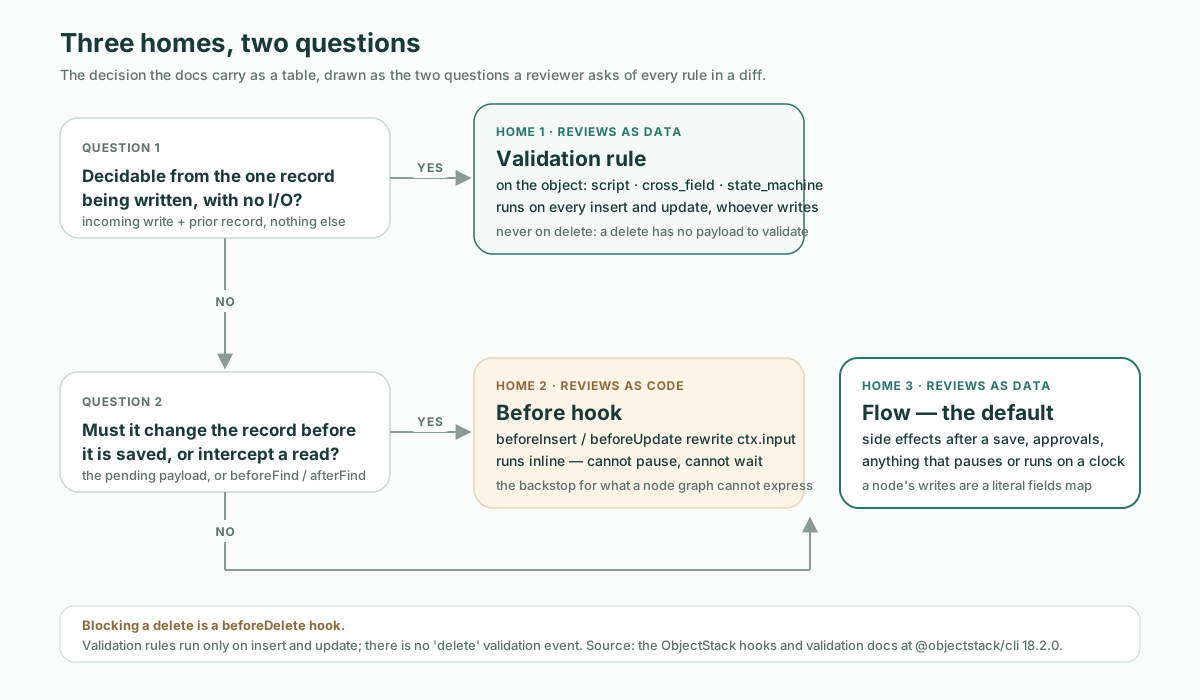
Two things in that table are easy to get backwards. Validation rules never run on delete — a delete carries no record payload to validate — so “an opportunity with open line items cannot be deleted” is a beforeDelete hook, not a rule. And “default” is the doc’s word, not a soft preference: when a hook and a flow could both express a rule, the flow wins unless the rule needs something only a hook has, which is the pending record or a read event.
Seven rules, one CRM
The CRM example at the 18.2.0 tag declares seven business rules across its six objects. Here they are, each with the home it lives in and the row of the table that put it there. The count is the number in the title; re-count it yourself from the validations arrays in src/objects/*.object.ts, plus src/hooks/ and src/flows/.
| # | The rule, as a sentence | Home | Construct | Row of the table |
|---|---|---|---|---|
| 1 | A discount above 40% is refused without an approved exception | Validation on crm_opportunity — discount_cap | script, CEL predicate | Decidable from the record alone |
| 2 | An open opportunity cannot be created with a close date in the past | Validation on crm_opportunity — opp_close_date_not_past | cross_field, events: ['insert'] | Same predicate engine as script; the error attaches to close_date |
| 3 | Stages move in order; closed_won is terminal | Validation on crm_opportunity — opp_stage_transitions | state_machine | Prior state plus next state, no I/O |
| 4 | Lead statuses move in order; converted and disqualified are terminal | Validation on crm_lead — lead_status_transitions | state_machine | Same |
| 5 | A lead score is between 0 and 100 | Validation on crm_lead — lead_score_range | script | Predicate |
| 6 | A won deal’s probability is 100, a lost deal’s is 0 | Hook — opportunity_stage_probability | beforeInsert, beforeUpdate | Changes the pending record in the same write |
| 7 | Converting a lead creates a customer and an opportunity and marks the lead converted — once | Flow — crm_convert_lead_wizard | Screen flow; update_record node | Pauses for input, creates records, writes another object |
Rule 6 is the only hook, and it is worth reading in full, because it is exactly the shape the table reserves for hooks — a mutation of the record on its way in, and nothing else:
// examples/app-crm/src/hooks/opportunity.hook.ts  (@objectstack/[email protected])
export const OpportunityStageHook = defineHook({
  name: 'opportunity_stage_probability',
  object: 'crm_opportunity',
  events: ['beforeInsert', 'beforeUpdate'],
  priority: 100,
  handler: async (ctx: HookContext) => {
    const input = ctx.input as { stage?: string; probability?: number };
    if (input.stage === 'closed_won') input.probability = 100;
    if (input.stage === 'closed_lost') input.probability = 0;
  },
});
Rule 7 is the only flow, and its last node is the one that writes. Its write set is not code; it is a literal map of field names next to a literal object name, and the two values it computes are CEL value envelopes — still data, not a function body:
// examples/app-crm/src/flows/convert-lead.flow.ts  (@objectstack/[email protected])
{
  id: 'update_lead',
  type: 'update_record',
  label: 'Mark Lead Converted',
  config: {
    objectName: 'crm_lead',
    filter: { id: { dialect: 'cel', source: 'recordId' } },
    fields: {
      status:                'converted',
      account:               { dialect: 'cel', source: 'account_id' },
      converted_opportunity: { dialect: 'cel', source: 'opportunity_id' },
    },
  },
},
Hold those two shapes side by side. They are the whole argument.
Three homes at the API
Boot the example on 18.2.0 (objectstack dev --compile), sign in once as the dev admin the server seeds on an empty database — the boot banner prints the account — and drive the generated REST API. Four calls, one per rule shape.
Home 1, a script validation. Create an opportunity at a 45% discount:
POST /api/v1/data/crm_opportunity
{ "name": "Acme — Deep Discount Deal", "account": "<acme id>", "stage": "prospecting",
  "amount": 50000, "discount_percent": 45 }

400 { "error": "Discount cannot exceed 40% without an approved exception.",
      "code": "VALIDATION_FAILED",
      "fields": [ { "field": "_record", "code": "rule_violation",
                    "message": "Discount cannot exceed 40% without an approved exception." } ],
      "object": "crm_opportunity" }
The same call at discount_percent: 40 returns 201 and a record stamped probability: 50, the field’s declared default. The message is the one authored on discount_cap; the anchor is _record, because a plain script rule attaches to the record as a whole.
Home 1 again, a cross_field validation. Create one with close_date in the past:
POST /api/v1/data/crm_opportunity
{ "name": "Acme — Back-dated Deal", "account": "<acme id>", "stage": "prospecting",
  "amount": 10000, "close_date": "2026-01-15" }

400 { "error": "Close Date must be today or a future date.",
      "code": "VALIDATION_FAILED",
      "fields": [ { "field": "close_date", "code": "rule_violation",
                    "message": "Close Date must be today or a future date." } ],
      "object": "crm_opportunity" }
Same engine, same envelope, one difference: the error is anchored on close_date, because cross_field “evaluates identically to script” and fields[0] is what “labels the field the error attaches to”. That is the entire distinction between the two types, and it is a presentation choice, not an enforcement one.
Home 2, the before hook. Take the seeded “Acme — Q3 Platform Renewal” — stage proposal, probability 70 — and close it:
PATCH /api/v1/data/crm_opportunity/WQwHS5B2yI9pOTqc
{ "stage": "closed_won" }

200 { "record": { "name": "Acme — Q3 Platform Renewal", "stage": "closed_won",
                  "probability": 100, "expected_revenue": 120000, … } }

GET /api/v1/data/crm_opportunity/WQwHS5B2yI9pOTqc
200 { "record": { "stage": "closed_won", "probability": 100, … } }
Nobody sent probability. The hook rewrote the pending record before the engine saved it, and the read-back agrees. This is the row of the table the docs reserve for a before hook — “mutating the pending record in the same write, before it is saved” — because a flow’s update_record node hands its fields to the engine as an ordinary caller payload, a write of its own, rather than editing the one already on its way in.
Home 1, a state_machine validation. Take “Initech — Expansion” — stage prospecting — and try to close it in one jump:
PATCH /api/v1/data/crm_opportunity/WsD7hH7IEgUvPhDK
{ "stage": "closed_won" }

400 { "error": "Invalid stage transition.",
      "code": "VALIDATION_FAILED",
      "fields": [ { "field": "stage", "code": "invalid_transition",
                    "message": "Invalid stage transition.", "label": "Stage",
                    "constraint": { "from": "prospecting", "to": "closed_won" } } ],
      "object": "crm_opportunity" }
prospecting → qualification, a declared transition, returns 200. Whether the hook rewrote probability before the predicate refused the write is invisible from outside, and it does not matter: the write never landed, and the record stays what it was.
Three homes, three distinguishable envelopes: a rule failure carries VALIDATION_FAILED and the authored message; a hook leaves no trace except the value it changed — and when a hook does refuse, the docs say, the API answers 400 with the code VALIDATION_ERROR, not a rule’s VALIDATION_FAILED; a flow — rule 7 — is driven from a screen, so it has no single REST call, which is itself a fact about where it lives.
The same typo in two homes
Here is the measurement the table’s “why” column rests on. Take one mistake — a field name misspelled in a write — and plant it in the flow and in the hook. Then run os validate on 18.2.0.
In the flow’s update_record node, misspell converted_opportunity:
✗ Author-time rules failed (1 issue)
  • flow "crm_convert_lead_wizard" › node "Mark Lead Converted": update_record
    writes 'converted_oportunity', but object 'crm_lead' declares no such field,
    so the write is refused (INVALID_FIELD / 400) and the step fails the run
      fix: Did you mean 'converted_opportunity'? Fix the field name, or declare
      'converted_oportunity' on the object
      rule: flow-node-write-unknown-field  at flows[0].nodes[6].config.fields.converted_oportunity
      — `os explain flow-node-write-unknown-field` for why an undeclared field write is refused
exit=1
In the hook body, misspell probability in the literal form the write-set lint recognizes — ctx.input.probabilty = 100:
✓ Validation passed (542ms)
  …
  ⚠ hook "opportunity_stage_probability" › body: body writes 'probabilty' to its
    input, but object 'crm_opportunity' declares no such field, so the write is
    refused (INVALID_FIELD / 400) (judged on the metadata body lowered from the
    inline handler)
    fix: Did you mean 'probability'? Fix the field name, or declare 'probabilty'
    on the object
    rule: hook-body-write-unknown-field  at hooks[0].handler
    — `os explain hook-body-write-unknown-field` for why an undeclared field write is refused
exit=0
Same mistake, same fix, two strengths. Both answers spell the fix out — Did you mean …? — and what differs is the strength and the anchor: the flow node is an error, pinned to the exact fields key, with a non-zero exit; the hook body is a warning, pinned to the whole handler, and the build is green. The docs say why in one sentence: the node’s fields “is a literal map next to a literal objectName, so nothing could have mis-read it”, whereas a hook body’s write set is checked “only for the literal patterns a parser can recognise”. The existence of a field is a certainty when the write is data and a best effort when the write is code. (The elided lines in the second transcript are the stack summary; the nine field-no-consumers advisories the clean run also prints follow the hook warning.)
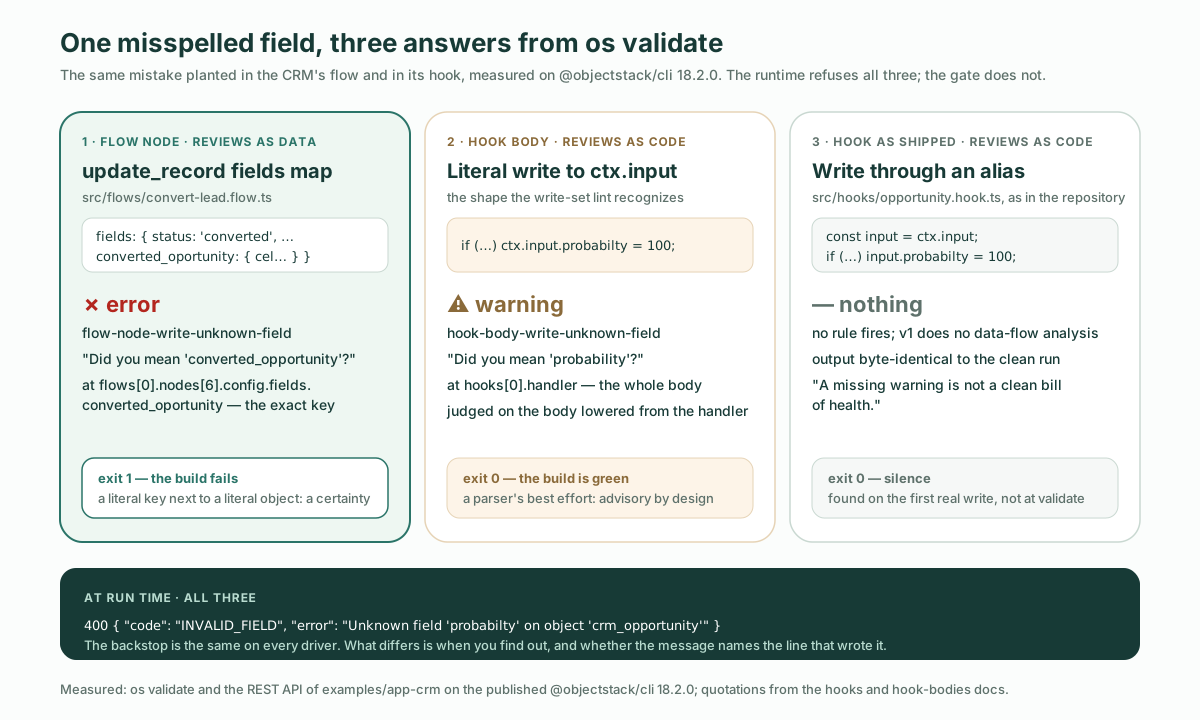
And there is a third answer, which is the one that should change how you review. The CRM’s hook, as shipped, does not write ctx.input.probability directly. It writes through a local alias — const input = ctx.input; … input.probability = 100 — and the docs list aliased input among the shapes the rule “bails silently on”, because “v1 does no data-flow analysis”. Misspell the field in the hook exactly as it is written in the repository and os validate says nothing: exit 0, no warning, output byte-identical to the clean run. The docs’ own line for this is the one to memorize: “A missing warning is not a clean bill of health.”
All three land in the same place at run time. The CRM’s write path refuses an unknown field on every driver, and it does so for a hand-typed payload too:
PATCH /api/v1/data/crm_opportunity/emhPM9WKJqqGzaME
{ "probabilty": 100 }

400 { "error": "Unknown field 'probabilty' on object 'crm_opportunity'",
      "code": "INVALID_FIELD", "field": "probabilty", "object": "crm_opportunity" }
So the mistake is never persisted. What differs is when you find out and who tells you: the flow at validate, with the fix spelled out; the literal hook at validate, advisory; the aliased hook on the first real write, from a refusal that names the field and not the body that wrote it.
Reviewable as data, reviewable as code
Call the property reviewable as data. A rule is reviewable as data when its meaning is carried by structured metadata the gate can resolve against the declared schema — a fields map, a transitions table, a CEL condition — so that the reviewer reads a diff of values and the validator reads the same values with certainty. A rule is reviewable as code when its meaning is carried by a function body: the gate can parse the literal shapes and must bail on the rest, and the reviewer reads logic, not values.
Every validation rule in the CRM is reviewable as data. The state_machine is the cleanest case — a reviewer can read closed_won: [] and know, without running anything, that a won deal is terminal. The flow’s update_record node is reviewable as data; the docs put it directly: “The node graph diffs field-by-field and renders in the Console designer with per-node run history; a hook body reviews as code only.” The hook is reviewable as code, and the CRM’s hook is a good hook precisely because its code is three lines whose job no data shape can express — rewriting the record on its way in.
This gives the reviewer of an AI-written change a question that is faster than “is this right?”: is this rule in the home where it is reviewable as data? A threshold inside a hook body, a status transition enforced by an if in a handler, an approval implemented by a hook that throws — each parses, builds and runs, and each is a finding, because the same rule has a home where the gate would check it as a value and the reviewer would read it as one. The fix is not to review the code harder. It is to move the rule.
The docs close the one loophole in that argument. Logic that genuinely needs code “still doesn’t have to be a hook: a flow script node calling a function registered via defineStack({ functions }) keeps the orchestration in checked metadata and the code in one named, testable unit.” Code goes in the smallest box; the shape around it stays data.
What this does not settle
- The threshold. Nothing above says whether 40% is the right cap, whether finance is the right approver, or whether the stage order matches how the business sells. A rule in the right home is still a rule a human has to agree with; this piece only makes the disagreement cheap to find.
cross_fieldis not a stronger check. It runs the same predicate asscript. If you reach for it expecting the engine to do something extra across fields, it will not; you are choosing where the error message lands.- The write-set lint is bounded by a parser. Computed keys, spreads, dynamic object names, aliased input and objects declared by another package are all invisible to it, by design — a false positive would kill an advisory lint. The runtime backstop is the same on every driver, but it is a backstop. The practical rule from the docs holds: treat
hook-body-write-unknown-fieldas a build failure by convention, and check by hand what the parser cannot see. - The CRM has no record-triggered flow. Its one flow is a screen wizard a user launches. The “someone approves the exception” half of the opening sentence is a flow with an
approvalnode, and the ObjectStack repository keeps its worked approval flows in the larger showcase example, not here. The decision table covers it; this CRM does not exercise it. - Seven is this CRM’s number, at
@objectstack/[email protected], and the three doc passages quoted above are read at that same tag. Re-run the transcript on whatever version you install: between two recent releases the count stayed at seven while the flow node’s computed values changed shape, from'{…}'templates to CEL value envelopes, which is exactly the kind of drift a re-run catches.
Point your agent at the table
The cheapest way to get rules into the right home is to tell the agent the table before it writes the first one. Three lines in an AGENTS.md, or in whatever rules file your agent reads, are enough:
A business rule that can be decided from the one record being written, with no I/O,
is a validation rule on the object (script / cross_field / state_machine). A rule that
must change the record before it is saved is a before hook. Everything else — side
effects, approvals, anything that pauses or runs on a clock — is a flow. Flows are
the default; hooks are the backstop. Validation rules never run on delete.
Then review the diff for one thing: a rule living where it is reviewable as code when a home exists where it is reviewable as data. The gate will have already told you which it is — once as an error, once as a warning, and once, if the hook aliases its input, not at all.
That is the loop the target format is built for. One executable business ontology. AI writes it, the runtime runs it, agents operate it, you own it. The seven rules above are the ontology’s verbs, and every one of them is in a file you can read.
npm create objectstack@latest crm && cd crm
pnpm run validate     # the gate, every edit
pnpm run dev          # the API, with the dev admin printed in the banner
Related: how one CRM was built with an agent, including what broke, where rule 3’s state_machine first appeared; the four-pass review order, which this piece gives a fifth question; the trigger model for where a flow starts; and the glossary entry for declared vs. enforced, the gap a rule in the wrong home quietly reopens.