AI Project Management Assistant: Surfacing the Risk Hidden in Status Updates
An AI project assistant is not another board. It models projects, tasks, meetings, risks, changes, and action plans so AI can detect delays and blockers from everyday updates.
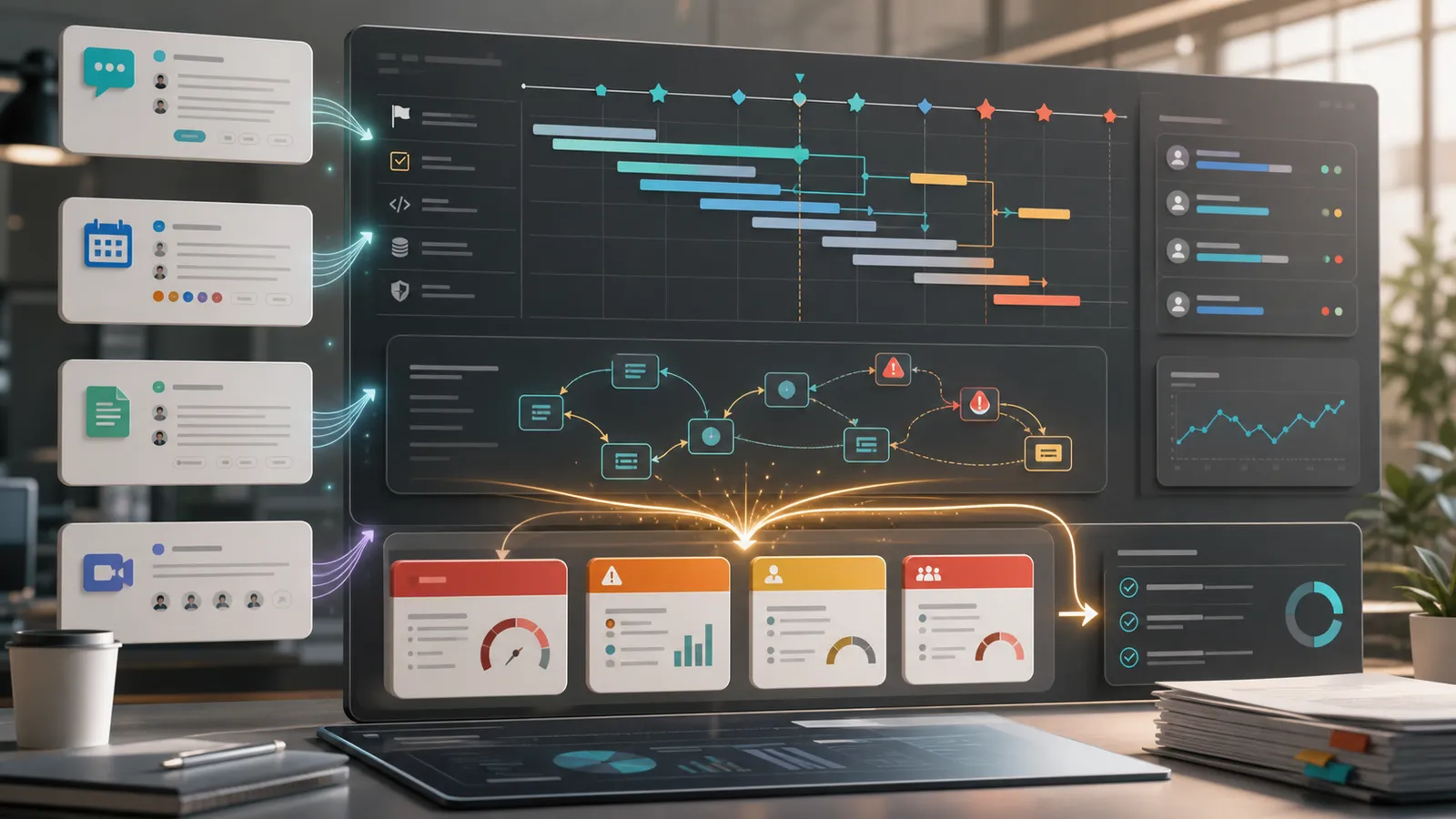
The short version: An AI project assistant isn’t another board — it models projects, tasks, meetings, risks, changes, and action plans as metadata, so AI surfaces the risk hidden in status updates, while the response still lands in concrete actions.
Project risk rarely announces itself. It appears as small comments in meeting notes, task updates, weekly reports, change requests, and resource conversations.
An AI-native project management assistant starts differently. It treats natural language as both the way the application is built and the way people use it. The builder translates a business request into objects, fields, relationships, views, permissions, workflows, and governed agent tools. The application then lets project managers ask questions, update records, generate drafts, and trigger actions in the same language they use at work.
You can start with a request like this:
Build an AI project management assistant. Manage projects, tasks, milestones, meeting notes, risks, change requests, and action plans. AI should identify delays, blockers, dependency conflicts, and resource risks from updates, then help managers ask natural-language questions about project health.
The goal is not a quick generated screen. The goal is a durable business application that can evolve as the team learns.
Why This Scenario Is AI-Native
This is not a traditional application with an AI button added later. Project delivery is a setting where the work itself contains language, judgment, context, and repeated decisions.
In this scenario, AI matters because:
- risk signals are textual and scattered;
- impact depends on milestones, dependencies, critical path, and customer commitments;
- AI can detect and explain risk, but commitments must remain human decisions;
That combination makes the application a good fit for metadata-driven building. The system needs to understand business objects before it can safely generate pages, automation, and agent actions.
The Metadata the Builder Should Generate
The first output should not be a page mockup. It should be the business model that makes the app runnable. For this AI project management assistant, the core objects are:
| Object | Purpose |
|---|---|
project | A governed business object used by UI, API, workflows, permissions, and AI tools. |
milestone | A governed business object used by UI, API, workflows, permissions, and AI tools. |
task | A governed business object used by UI, API, workflows, permissions, and AI tools. |
meeting_note | A governed business object used by UI, API, workflows, permissions, and AI tools. |
project_risk | A governed business object used by UI, API, workflows, permissions, and AI tools. |
change_request | A governed business object used by UI, API, workflows, permissions, and AI tools. |
action_plan | A governed business object used by UI, API, workflows, permissions, and AI tools. |
These objects are not just database tables. They define what the AI is allowed to read, what it may suggest, what it can change after confirmation, and what must go through approval. Views, filters, forms, dashboards, and agent tools all come from the same metadata.
Natural Language Keeps Shaping the App
The first version is never the final version. Business teams should be able to keep changing the application by describing the rule they want, while the platform turns that description into metadata changes.
For example, a project director might say:
Create medium risk when critical-path work is two days late and high risk after five days.
The platform should translate that into fields, filters, validation, views, automation, and permissions. Another request might be:
Do not allow customer scope changes into development before impact assessment is completed.
Again, the change should not live only in a prompt. It should become part of the application model so UI, API, workflow, and agent behavior stay aligned.
How People Work Inside the App
The second layer of natural language is the user experience. A project manager should be able to ask:
What is most likely to delay this project now?
A useful answer should use the application model to:
- connect meeting notes to tasks and milestones;
- detect blockers, dependencies, and resource conflicts;
- create risk records with suggested actions;
- summarize risks for project and portfolio reviews;
That is the shift: people start with the business question, and the application uses structured metadata to answer, explain, and propose the next action.
AI Can Execute, But Only Within Boundaries
The more useful the AI becomes, the more explicit the action boundary must be. Some work can be automatic, some should require user confirmation, and high-risk actions must go through approval.
For this application, summaries, classification, draft generation, internal reminders, risk flags, and reporting can usually run automatically. Task creation, status updates, routing, and operational record changes should ask for confirmation. Customer-facing commitments, money movement, contract terms, access changes, data export, and audit closure should require approval.
That boundary is what makes AI usable in production. The model can reason and suggest, but the runtime decides whether the action is allowed, whether confirmation is required, and how the result is recorded.
A Practical First Build
A practical first version should be narrow enough to ship and structured enough to grow:
- model project, milestone, task, meeting, risk, change, and action-plan objects.
- extract decisions, to-dos, and risk signals from notes.
- start with delay, dependency, resource, and scope-change rules.
- let managers ask health questions in natural language.
- turn accepted risks into action plans.
This sequence creates value before full automation. Teams can first validate AI understanding, then add confirmation, then automate the parts that are low-risk and repeatable.
What ObjectStack Adds
The assistant makes project reality queryable. Risks can be seen, discussed, and assigned before they become missed commitments.
ObjectStack helps here because the same metadata supports both natural-language building and natural-language operation. Objects define meaning, permissions define access, workflows define execution, and audit records show what AI suggested, what humans confirmed, and what the system finally changed.