Fabric IQ vs Palantir vs Unity Catalog vs Snowflake vs Looker: The 2026 Ontology Comparison
Five vendors shipped an enterprise ontology or semantic layer between November 2025 and August 2026. A cell-by-cell comparison of objects, relationships, actions, permissions and agent interfaces, sourced to vendor docs.
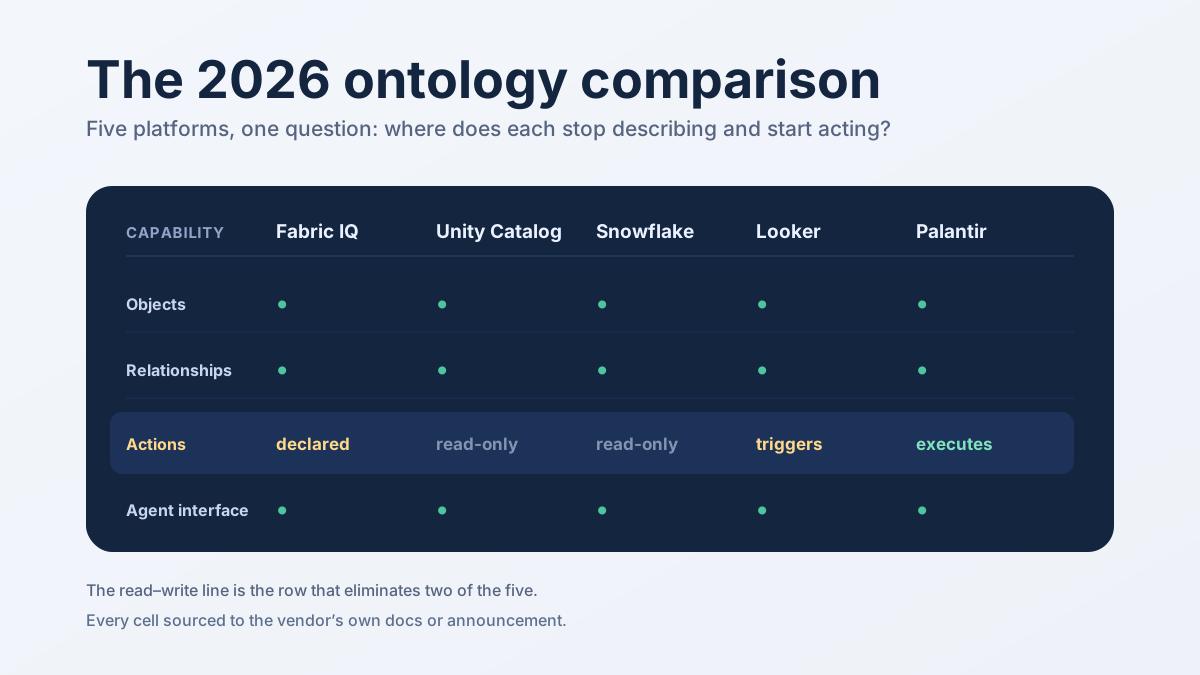
The short version: all five platforms model business objects and the relationships between them. Only three model actions — the operations that change the business, not just describe it. Only one of those executes actions as a transaction inside the ontology itself. That single row is the difference between a semantic layer your agent can read and an ontology your agent can act in, and it is the row most comparison posts get wrong.
Call it the read–write line: the point where a platform stops describing your business and starts changing it. Every cell below is sourced to the vendor’s own documentation or announcement. Of the 30 cells in the main table, 29 could be confirmed from a vendor source; the one that could not is marked Unverified rather than guessed.
This post is the table. The argument about who should own this layer — and why fragmentation, not lock-in, is the expensive failure — is a separate piece: Open vs. Closed Enterprise Ontologies.
1. What each vendor actually shipped, and when
The category did not arrive at once. It arrived across nine months, from four different starting positions — a data platform, a lakehouse, a warehouse, a BI tool — plus the incumbent that has had an ontology for years and spent 2026 doing something else with it.
| Platform | What shipped | When | Status today |
|---|---|---|---|
| Microsoft Fabric IQ | Ontology item + agent workload | Ignite 2025, Nov 18–21 | Public preview |
| Databricks Unity Catalog | Business Semantics, metric views | 2026 | GA |
| Snowflake | Semantic View Autopilot | Feb 3, 2026 | GA |
| Google Looker | BI Agents on the LookML semantic layer | Next ’26, Apr 22, 2026 | Mixed — see below |
| Palantir Foundry | SuperRepo: Ontology-as-code | Week of Aug 3, 2026 | Beta |
Five notes that change how you read that table.
Microsoft entered highest up the stack. Fabric IQ is a full workload, not a feature: Ontology, Graph, Data Agent and Operations Agent as separate items. The Ontology item “defines core business entities, relationships, properties, rules, and actions” and is authored with no-code visual tools so business experts can build the model without waiting on data engineers. It is still in public preview, and Microsoft has not announced a GA date.
Snowflake and Databricks entered from analytics, and both bet on automation over authoring. Snowflake’s Semantic View Autopilot autogenerates semantic views from your existing query history and BI assets — its stated premise is that your semantics are already defined in the SQL people run and the dashboards they trust, so modeling becomes curation rather than authoring. Databricks made Business Semantics GA during 2026 and is open sourcing the core metric-view implementation into Apache Spark.
The missing month on the Databricks row is deliberate. Databricks published a semantics-layer GA announcement, and separately a Data + AI Summit round-up in June 2026 carrying Business Glossary and Domains. The two are easy to conflate, and we could not open the vendor’s own announcement to settle which of them carried the GA. So this table says 2026 rather than attributing a month we cannot source. What is well sourced is the June 2026 summit as the moment Glossary and Domains landed on top of Business Semantics — which is a different claim from when the GA happened.
Google entered from the BI seat, and its row is thinner than the other four. Looker’s agentic BI updates were announced at Google Cloud Next ’26 on April 22, 2026, and the framing is explicitly agent-first: Looker BI Agents “don’t just provide static answers, but trigger downstream business actions grounded in the Looker semantic layer and your existing enterprise governance framework.” What shipped is a mix of states rather than one release. The Conversational Analytics agent “is already GA”, and embedding those agents in your own applications went GA alongside it; the upgraded Conversational Agents, Dashboard Agents, agentic workflows and the Knowledge Catalog integration are all preview. Knowledge Catalog is the former Dataplex under a new name, and it is where, per Google, “Looker transforms metadata into a semantic graph, providing the essential context AI agents need to complete tasks autonomously.” Every Google cell below traces to that one announcement — a single launch post, against four vendors’ documentation sets for the others — so those cells are written at the granularity it supports and no further. Where the other four columns cite an action model or a permission model, Google’s column cites an announcement of one.
Palantir did not ship an ontology in 2026 — it already had one. What it shipped is the thing the other four are converging toward: SuperRepo, a single monorepo holding Ontology definitions, functions and the React application, developed and deployed as one versioned artifact. Object types, links, interfaces and actions are declared in TypeScript, and those code definitions are the source of truth. Hold that thought for section 5; it is the most uncomfortable fact in this post.
2. The comparison table
Six capabilities, five platforms. Cells are deliberately terse so this reads on a phone; the sourcing for each is in section 7.
| Capability | Fabric IQ | Unity Catalog | Snowflake | Google Looker | Palantir Foundry |
|---|---|---|---|---|---|
| Business objects | Entity types | Metric views | Logical tables | Explores, LookML dimensions | Object types |
| Relationships | Typed, graph view | Joins in the view | Joins on shared keys | Semantic graph (preview) | Link types |
| Actions | Declared, delegated | Read-only by design | Read-only by design | Triggered downstream | Native, transactional |
| Permissions | Item-level sharing | Inherited from UC | Public/private fields | Inherited from Looker | Object + dynamic |
| Agent interface | Ontology MCP (preview) | Genie, AI/BI | Cortex Analyst, MCP | Conversational Analytics, MCP | Ontology MCP, OSDK |
| Definition portable | Unverified | Spark OSS, OSI | YAML spec | LookML, version-controlled | Git repo, Foundry-bound |
On the two “read-only by design” cells. This is a positive claim, not an absence claim. Databricks documents metric views as read-only query objects — creating one “does not process or write any data. Only the query text is registered to the metastore.” Snowflake semantic views are queried by putting a SEMANTIC_VIEW clause in a FROM clause. Neither product is missing actions; neither is trying to have them. They are semantic layers over a warehouse, and a warehouse semantic layer that wrote back to operational systems would be a different product.
On Google’s “triggered downstream” cell. This is the weakest-sourced cell in the table and it is worth saying why it is not simply “declared, delegated” like Fabric IQ’s. Google states that BI Agents “trigger downstream business actions”; it does not, in that announcement, describe an action type, a transaction boundary, or what executes the action. Fabric IQ’s cell names its executor because Microsoft’s documentation names it. Google’s does not, so the cell records the claim and stops there. If Google documents the action model, this cell gets more specific — and possibly moves.
On the Unverified cell. I could not confirm from Microsoft’s own documentation whether a Fabric IQ Ontology item’s definition can be exported as a file you hold and version yourself. The MCP endpoint exposes the ontology to agents, and Azure AI Search knowledge sources reference it by workspaceId and ontologyId — but a pointer is not the definition. If Microsoft ships or documents an export path, this cell changes and the lock-in profile in section 4 changes with it.
3. Where each one stops — the read–write line
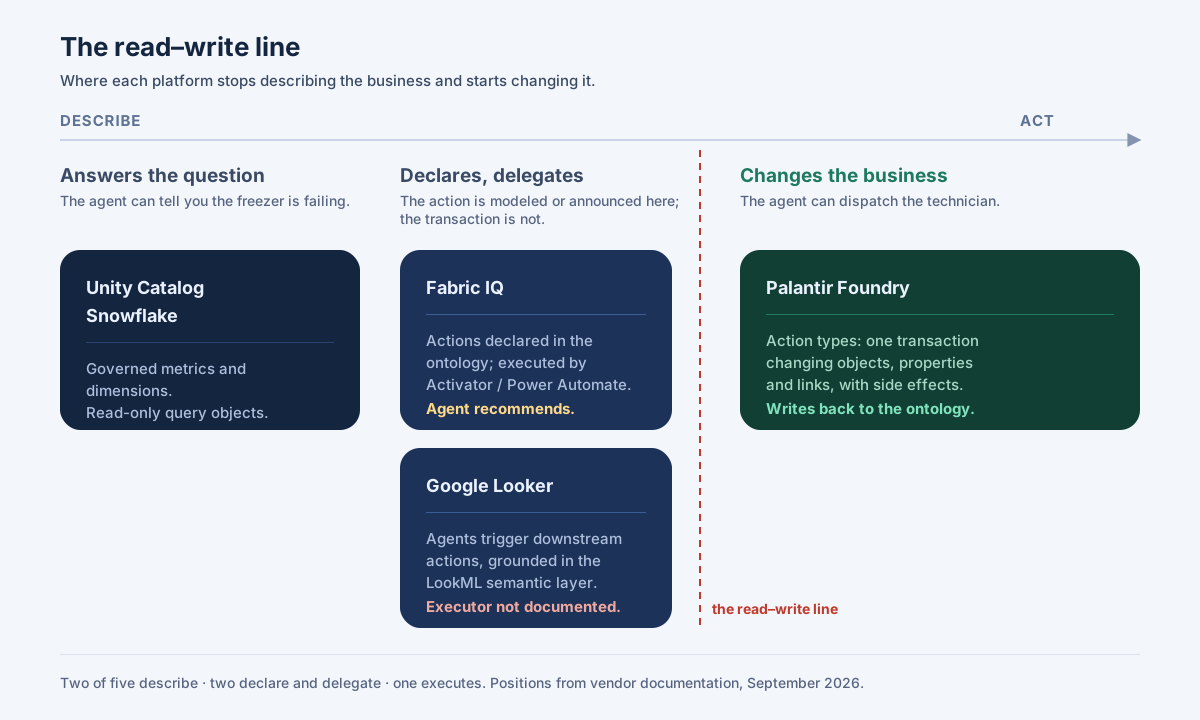
Unity Catalog and Snowflake stop at the answer. A metric view or a semantic view gives an agent one governed definition of “revenue” so that the dashboard, the notebook and the agent all return the same number. That is a genuinely hard problem and both solved it well. The agent can then tell you the freezer is failing. It cannot dispatch the technician.
Fabric IQ declares actions but delegates execution. The ontology models actions as operations on entities — the documentation’s own examples are “reroute aircraft, schedule repair, notify pilot” — and every action is connected to the workflow in an operational system that executes it. In practice you configure an action with Activator and a Power Automate flow, and the Operations Agent recommends actions rather than committing them. So the action is real and it is modeled in the ontology; the transaction, the retry semantics and the audit trail live in whatever the action is wired to.
Google Looker sits beside Fabric IQ, on one sentence rather than a model. The announcement puts the agents on the same side of the line: BI Agents “trigger downstream business actions grounded in the Looker semantic layer and your existing enterprise governance framework,” and the agentic workflows it describes monitor metrics and surface “what’s next” recommendations. Both halves of that — grounded in a governed semantic layer, executing somewhere else — are the declare-and-delegate shape. The difference from Fabric IQ is evidential, not architectural as far as anyone outside Google can tell: Microsoft documents the action, the executor and the recommend-don’t-commit behaviour, and Google has announced the capability. Treat the placement as provisional.
Palantir executes actions inside the ontology. An action type is “the definition of a set of changes or edits to objects, property values, and links that a user can take at once”, including side-effect behaviors on submission, and an action is “a single transaction that changes the properties of one or more objects.” Palantir’s own framing splits the ontology into semantic elements (objects, properties, links) and kinetic elements (actions, functions, dynamic security). Edits land in the object type’s writeback dataset. This is the mature implementation of the thing the other four are approaching from different sides, and pretending otherwise would make this table useless.
So the honest score on actions is 3–2, not 4–1. The lazy version of this post says “only Palantir has actions.” That is wrong: Fabric IQ models them too, and Google says its agents trigger them. The accurate version is that five platforms sit at three different places on the read–write line — two describe, two declare and delegate, one executes — and which one you need depends entirely on whether an agent reading your ontology is expected to do anything.
4. Lock-in profile
Lock-in is not one thing. Three questions separate the platforms, and the answers are less one-sided than the category’s reputation suggests.
| Question | Fabric IQ | Unity Catalog | Snowflake | Google Looker | Palantir |
|---|---|---|---|---|---|
| Definition in a file you hold | Unverified | Yes (Spark OSS) | Yes (YAML) | Yes (LookML) | Yes (monorepo) |
| Runs off the vendor | No | Spark OSS path | No | No | No |
| In an open standard body | Not named | Named member | Co-founder | Not named | Not named |
The honest counterweight: this category is standardizing, and quickly. Snowflake co-founded the Open Semantic Interchange with Salesforce, dbt Labs, BlackRock and RelationalAI in September 2025 — a vendor-neutral, Apache-2.0 spec for exchanging semantic models (metrics, dimensions, relationships) between platforms. Spec v0.1 was finalized in January 2026. In July 2026 the initiative entered the Apache Incubator as Apache Ossie, with 50+ member organizations including Databricks, Oracle and Collibra. Databricks is separately open sourcing the metric-view implementation into Apache Spark.
That matters for anyone arguing that a closed platform is definitionally a trap. Two of the five are actively moving their definition format toward a neutral standard body. If Ossie succeeds, “my metrics are portable” stops being a differentiator for anyone.
Two limits worth stating just as plainly. First, Ossie covers analytical semantics — metrics, dimensions, relationships. Actions and permissions, the two rows where these platforms differ most, are not in scope, so the read–write line is exactly where portability currently stops. Second, portability of the definition is not portability of the system: a Snowflake semantic view exported as YAML still needs a Snowflake to run against, and a SuperRepo still materializes onto a Foundry enrollment.
5. Which to pick, by starting position
Nobody picks one of these on features. You pick the one that matches where your data and your engineers already are.
Your business already runs on Microsoft 365 and OneLake. Fabric IQ, and the fact that it is still in preview is the main cost. You get the highest-level model of the five, authored by business experts rather than engineers, and actions that reach Power Automate. Watch the export question before you model your entire company in it.
Your analytics team lives in Databricks. Unity Catalog Business Semantics. It is GA, the permission model is the one your team already administers, Genie is grounded in it, and the open-sourcing into Spark gives you the strongest portability story of the five. Do not expect it to operate anything.
Your warehouse is Snowflake and you have years of query history. Semantic View Autopilot is the only product here that bootstraps the model from what your organization already does, instead of asking a committee to define “revenue” from scratch. If your obstacle is the six-month modeling project rather than the technology, this is the strongest answer on the list — and it is a genuine capability gap for everyone else, including the approach at the end of this post.
Your reporting layer is Looker and your analysts live in LookML. Google, and the reason is that you already did the modeling. LookML is a governed semantic layer your organization has been maintaining for years, in files under version control, and the 2026 announcement points the agents at it rather than asking you to build something new: Conversational Analytics is GA, a managed MCP server native to Looker is in preview, and Knowledge Catalog turns the metadata into a semantic graph for agents. The honest caveat is the one in section 2 — the agent story is a launch post, not yet a documented action model — so weigh it as the lowest-effort path from an existing semantic layer to agents, not as a settled answer on what those agents may change.
You need agents that act, with a transaction and an audit trail. Palantir Foundry, and it is not close. The kinetic half of the ontology is a decade of engineering and none of the other four have shipped an equivalent.
None of the above, or more than one of the above. That is the case the five platforms handle worst, because each is strongest inside its own estate — and it is the case the companion post is about.
6. Where an open business ontology fits — and where it does not
Full disclosure: we build one, so read this section as the interested party’s answer rather than a neutral verdict.
ObjectStack is an open business ontology: objects, relationships, permissions, flows and actions as typed metadata in your own repository, Apache-2.0, with a runtime that derives the database, REST API, UI and MCP server from it and enforces permissions and audit on every call. On the read–write line, it sits with Palantir: actions are permission-checked server operations, and every exposed action doubles as a governed MCP tool.
import { ObjectSchema, Field } from '@objectstack/spec/data';

export const Ticket = ObjectSchema.create({
  name: 'support_desk_ticket',
  label: 'Ticket',
  sharingModel: 'private',
  fields: {
    subject: Field.text({ label: 'Subject', required: true }),
    status: Field.select({
      label: 'Status',
      required: true,
      options: [
        { label: 'Open', value: 'open', default: true },
        { label: 'Resolved', value: 'resolved' },
      ],
    }),
  },
});
Now the part that belongs in an honest comparison. All five beat this approach on something real:
- Snowflake beats it on cold start. Semantic View Autopilot reads your query history and drafts the model. There is no equivalent here — you and your agent author the definition. If your problem is that nobody can agree on “revenue,” Snowflake’s answer is better than ours.
- Databricks and Snowflake beat it on analytical semantics. Metric views and semantic views carry aggregation semantics — facts, dimensions, metrics, semi-additive rules — over warehouse-scale data. An application ontology models objects and operations, not a metrics layer, and it is not a substitute for one.
- Palantir beats it on modeling depth and accountability. A decade of ontology engineering, forward-deployed engineers who will sit with your team, and one vendor on the phone when it breaks. An open format gives you the file; it does not give you someone to call.
- Fabric IQ beats it on who can author. Business experts building the model in a no-code visual tool is a different and broader distribution than “your coding agent writes typed metadata in a repo.”
- Looker beats it on the semantic layer you already have. LookML has been in place at these companies for years, and Google’s self-service Explores let someone blend an ad-hoc CSV into it while “the underlying business logic is still accurate.” Starting from a governed model your analysts already trust is a genuinely easier first step than authoring one, however portable the file we hand you is.
What is different here is narrower than “better”: the definition is an ordinary file in your repository under an open license, the runtime that enforces it is self-hostable, and both halves — semantic and kinetic — are in the same portable artifact rather than split across a portable spec and a proprietary execution engine. Whether that is worth more than modeling depth, autogeneration or ecosystem integration is a judgment about your starting position, not a fact this table can settle.
7. Sources
Every claim above traces to one of these.
- Microsoft Fabric IQ — What is Fabric IQ? · What Is Ontology (Preview)? · Introducing Fabric IQ · Use Ontology MCP Server · Create an Operations Agent
- Databricks Unity Catalog — GA and open sourcing of Business Semantics · Unity Catalog semantics · Metric views · Manage metric views
- Snowflake — Semantic View Autopilot GA press release · Semantic View Autopilot docs · Overview of semantic views · CREATE SEMANTIC VIEW · Snowflake-managed MCP server
- Google Looker — Looker updates for agentic BI at Next ’26 (April 22, 2026) · Knowledge Catalog, formerly Dataplex. The first of these is the only vendor-attributable source behind every Google cell above; the second is cited only for the rename.
- Palantir Foundry — Ontology overview · Action types · The Ontology system · SuperRepo · August 2026 announcements
- Open Semantic Interchange / Apache Ossie — OSI announcement · Ossie enters the Apache Incubator
Vendor documentation moves. Where a cell is time-sensitive — Fabric IQ’s preview status, the Unverified export cell, Ossie’s incubation — check the source before you quote this table in a decision document.
Closing
The useful question in 2026 is not “which ontology is best.” It is where on the read–write line do you need to be, because that single answer eliminates two of the five platforms immediately. If your agents only need to answer questions about the business, the two warehouse-native semantic layers are cheaper, GA today, and standardizing fast. If your agents need to change the business, the field narrows to platforms that model actions — and then the real question is who holds the definition when your vendor mix changes.
npm create objectstack@latest my-appModel one object, point your coding agent at it, and git commit the definition. Whatever you decide about the five platforms above, knowing what the definition looks like as a file you own makes the lock-in column much easier to read.